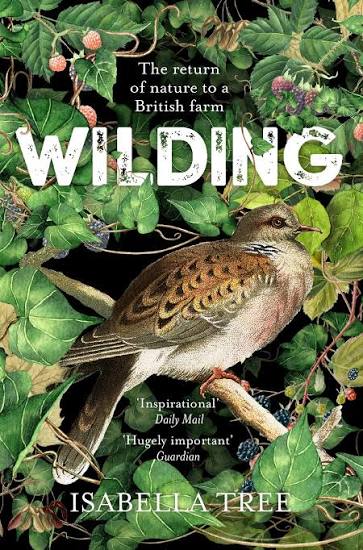
I visited Knepp Estate this summer for the second time, which motivated me to read the book I’d bought when I visited for the first time in 2025. A year is not a long time for a book to spend on my to-be-read shelf, and lately I’ve been enjoying thematic reading – when I travel I like to read something related to where I’m travelling to.
Wilding by Isabella Tree is the story of the transformation of the Knepp Estate from a failing conventional farm to what it is now – an ambitious wilding project and successful eco-tourism business. It’s a fascinating and lovely book (the first chapter is quite hard-going, but perseverance is rewarded) describing how the owners learned about the theories and concepts of re-wilding and applied them to the land at Knepp.
As well as the stories about selecting large herbivores and their impact on the landscape, and the subsequent, often unexpected, resurgence of smaller mammals, birds, insects and plant life, four things stood out to me. These were that the motivation for change was purely survival, the realities of food production and the prices farmers are paid, the impact of the post-WWII mindset around food security, and the lack of knowledge we have about what a wild landscape really looks like.
Tree describes how there were decades of trying to make Knepp Estate a farm that was profitable. Investments in machinery, fertilisers and higher-yielding herds and crops didn’t, in fact, pay off. However, it was not until the absolute crisis point of bankruptcy was reached that they thought about doing something different with the land. There had been seeds of ideas but they didn’t come to fruition until there was no other choice. All other options had been exhausted. In a summer where everything is on fire and climate disaster seems undeniable, this inability to change behaviours when there is still the possibility to keep doing what you’ve always done is strongly present still.
It was surprising to read about Tree’s experience of selling milk and the dynamics of the UK food market. There is a lot in the media about the prices that farmers get paid for their produce and how farmers can’t make a living. These stories are usually through the lens of evil supermarkets gouging powerless suppliers or consumers not being willing to pay fair prices. It turns out that this is because there is too much supply – prices for milk are low because there is so much milk available. Perhaps that’s obvious, but that’s not part of the usual narrative and it was one of those moments when you feel your perspective shift.
Related to the issue of over-production is the impact of the post-WWII mindset around food security on UK policy ever since. The UK had rationing for nine years after the end of the war due to food shortages. Before the war, much food was imported which stopped. The UK government ‘Dig for Victory’ policy was directed at putting as much land in the UK to producing food as possible. Even land like that at Knepp that wasn’t really suitable for it. This experience of near-starvation on a population level resulted in policies over the subsequent years aimed at food security (self-sufficiency) that had unintended consequences that have been detrimental to the quality of the land.
Happily, the story of Knepp (and of the other similar projects referenced in the book) show that regeneration can happen relatively quickly. The last insight I want to mention is that the process of wilding, regeneration and restoration is not well understood. Conservation projects have historically been carefully managed with high levels of human intervention. In many cases, they have sought to preserve landscapes that were curations of the 19th century and not ‘natural’ states. The wilding project at Knepp has produced information about the habitat preferences of species that were previously not known, because these species have been existing in the margins of their range. With more access to a variety of habitat, species are turning up in unexpected places. Which is wonderful.
This is a lovely book and very informative. Highly recommend.


Leave a Reply