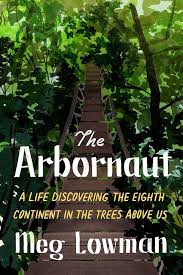
The Arbonaut

The Arbonaut is a memoir by Meg Lowman, a pioneer in ecology who developed techniques for reaching and studying forest canopies.

Meg covers her life as a scientist and the challenges of being a woman in science, including assault, dismissal, being underpaid and underrecognized. She also talks about the mentors she had along the way, mostly male, and how she tries to mentor young women coming up. It was interesting to read about her early explorations in answering questions about leaves when there was very little research documented in the journals. And also interesting to reflect on a time when papers could only be read in physical journals which came in the post. I’m not that young, but I’m very attached to having information instantly available.

There are chapters focusing on a few of the major projects she’s been involved in, such as Ethiopia’s Church forests, conservation in India’s Western Ghats, and counting species in Malaysian canopies. It’s sobering to read about deforestation and the loss of ancient woods. Planting new trees doesn’t make up for the loss of old ones, or, at least, it won’t for hundreds of years. Meg’s work has pivoted in her later career to focus on saving trees, setting up the Tree Foundation and launching Mission Green.

In between the chapters are short vignettes dedicated to types of tree, which I enjoyed a lot. It’s good to know more about trees.

This book was from my book subscription box, so probably not something I’d have picked up otherwise, but it’s worth a read. It’s insightful and you’ll definitely learn something!

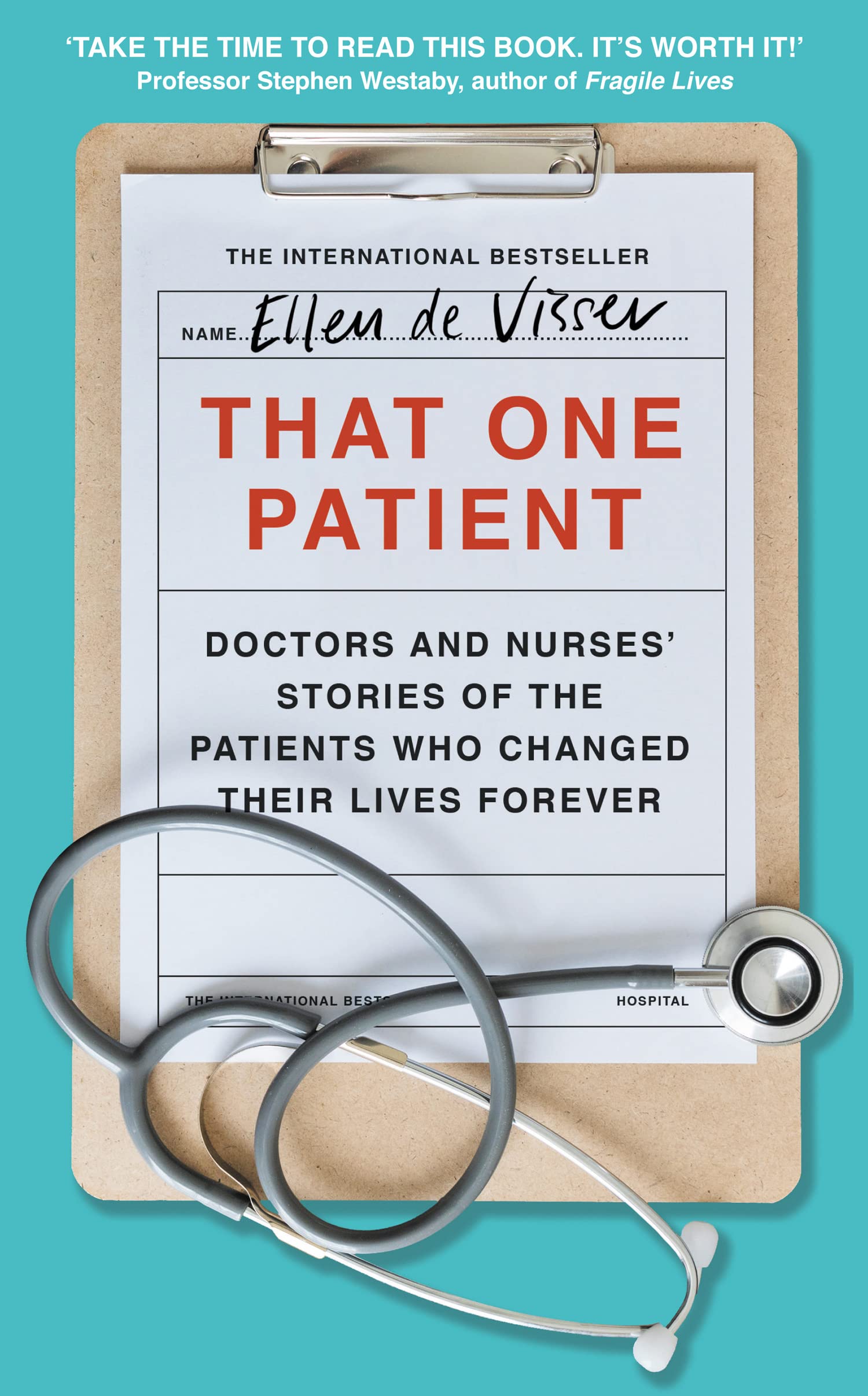
That One Patient

This year I decided to get a book subscription box. I mean, I don’t lack ways to buy news books but I do like getting a treat in the post. Tea Time Bookshop have lots of choices of different genres so I picked Science Fiction & Fantasy and Politics, Sciences & Insights. The book in the first PSI box was That One Patient by Ellen de Vissier.

It’s a collection of newspaper columns originally published in Dutch newspaper De Volkskrant. It didn’t immediately appeal to me. Then last weekend I was scouring the shelf for something to read. I’d decided I wanted an easy non-fiction read alongside the challenging novel I’m reading. This seemed to fit the bill.

Sidebar: I know I said I was having a trashy novel phase but that only lasted a few weeks. I’ll get back to it.

That One Patient surprised me. The columns are the stories of medical professionals about patients who had a profound impact on their lives and careers. I’d expected it to be full of sentimental stories about plucky patients pulling through against the odds. There is a little of that, and there’s so much more.

There are stories of patients whose lives and deaths inspired the development of better treatments for others. There are lots of stories of doctors realising that treatment isn’t always best, learning to respect patients’ wishes, and understanding that patients know their own bodies best. As the medical professionals are mainly Dutch and euthanasia is legal in the Netherlands there are several stories about that experience, and it was those I found the most nuanced, sensitive and thoughtful.

I would never have picked this book myself so I’m glad to have had it put in my way. I enjoyed it more than I thought I would. It’s good to have read something out of my normal pattern. I’m looking forward to finding out what’s in the next box.

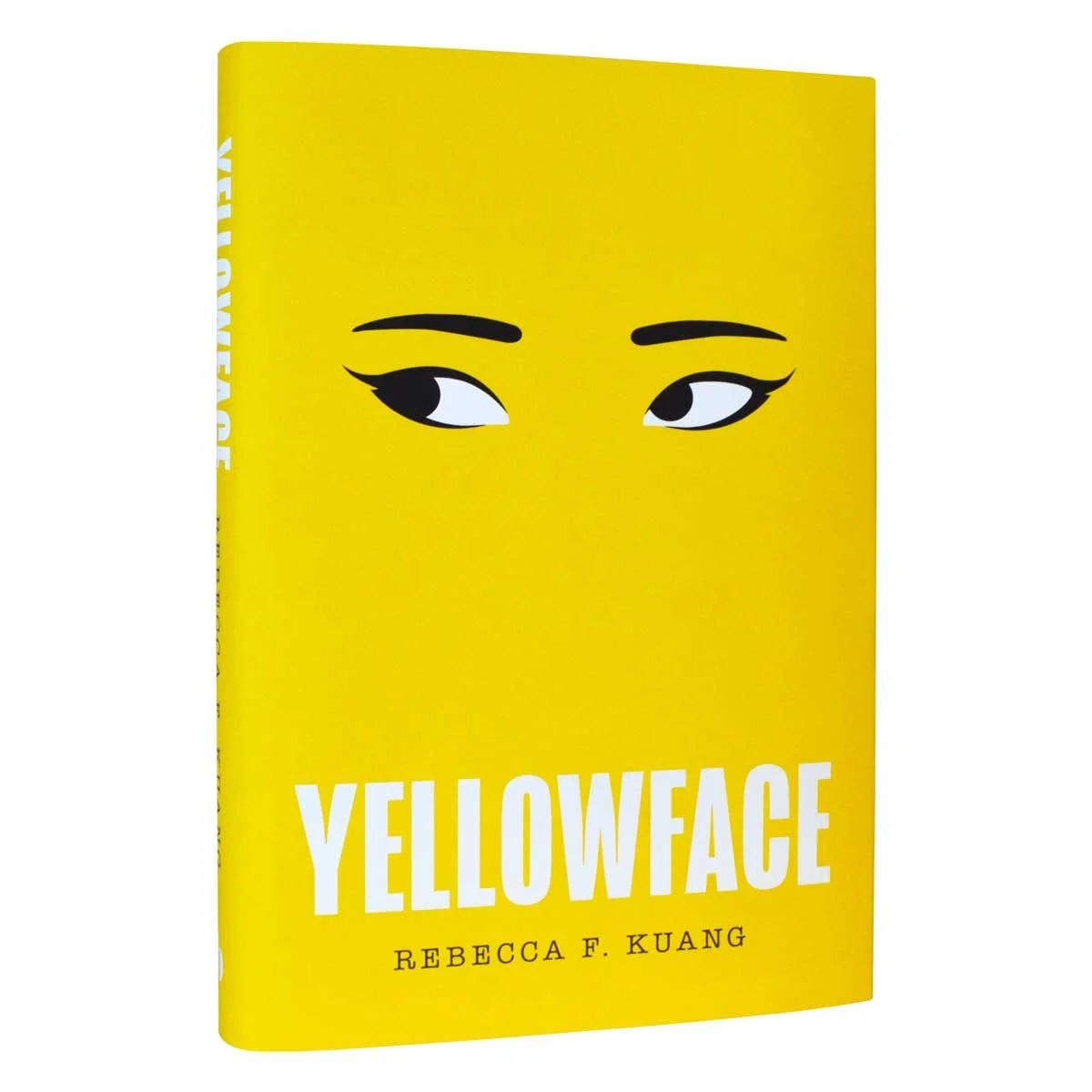
Yellowface

This book has been everywhere lately and I’ve seen lots of good reviews but it’s contemporary literary fiction which is not usually my kind of thing so I didn’t pick it up. When a friend recommended it and offered to lend it to me, I decided I would. Never turn down a free book!

Yellowface by Rebecca F. Kuang is the story of how a white author, June, steals a manuscript from her very successful Asian-American author friend Athena – on the night the friend dies. She takes a first draft of Athena’s next book and develops it and then it gets picked up by her publishers. It’s a success, much more so than her previous books. The publishers editing team supports her with the rewrites. I quite enjoyed the portrayal of how the edits suggested by the editor made the text more problematic – nuance and complexity being removed, foregrounding of white saviour characters – and how June is oblivious to the impact on the story. She’s more concerned with not being found out and being a ‘good’ author.

I also enjoyed the portrayal of the internet storm in a tea cup that develops around claims that June is claiming to be Asian when she’s not, through an ambiguous name change and author photo, and has plagiarized someone else’s work. It fizzles out and doesn’t matter much in the end, by June is thrown into depths of paranoia and guilt. But clueless and unself-aware as she is, June plows on and does it again. Under pressure to produce another book, June rifles through Athena’s notebooks and picks a short paragraph to flesh out into a novel. Unluckily for her, Athena developed this paragraph in writing workshop and the tutor remembers. June is also being haunted online by someone using Athena’s social media account, which adds a pleasing touch of mystery.

I liked it a lot. Enough to buy another of Rebecca Kuang’s books. It is perhaps not as deep and rigorous a critique of the publishing industry as it could be, and is not that literary after all (probably why I liked it), and belongs in that ‘trashy’ novel phase I’m having. It was a fun, easy read which was well-written and thought-provoking in places.

There is an interesting review of the book by @withCindy which I watched. It pulls out the complete lack of analysis around wealth and privilege that impacts success for all people that could have made this book more hard-hitting. I think the review is really on-point and worth watching. Yellowface is still a fun read.

2024 reading round up

I didn’t set a reading goal last year. I’m studying part-time and working full-time and, while I wanted to read more, a goal seemed like far too much pressure. Also, I find having goals sucks the fun out of things. Since I read Is it Really Green? I’ve been tracking what books I read so I make sure I read more than 25 books on my Kindle, which meant I had a tally at the end of the year. I read 33 ebooks, and 32 print books making a grand total of 65. Which is pretty good going under the circumstances.

Obviously, I’ve only blogged about one of those books, the excellent Infomocracy, so I thought I’d do a round up and pull out some highlights. I read the second and third books of that trilogy, Null States and State Tectonics, which were both just as good. Highly recommend.

Right at the beginning of the year I finally read Dreamsongs by G.R.R. Martin. It’s been on my TBR shelf for years: as it’s in hardback, I’ve quite possibly had it since not long after it was published in 2006. It is a retrospective of his life’s work with short stories from all phases of his writing life. There are a handful of really good stories including ‘The Second Kind of Loneliness’, ‘Sandkings’ and ‘Portraits of his Children’. It is interesting to see how his style and career progressed. I’m very glad I read it, and pleased to move it from the TBR shelf to the GRRM shelf (yes, he has his own shelf). It’s definitely one for the fans though.

The most fun books I read were The Murderbot Diaries by Martha Wells. I read the first two books in the series in 2023 and the remaining five last year. It is the story of a cyborg that has slipped the mental leash its owners had on it and gone rogue. Murderbot is trying to come to terms with the things it did in the past and to learn how to live as a free being, with the help of soap operas, a few progressive humans, and a similarly free AI transport ship pilot bot, Asshole Research Transport. It is very funny. Murderbot and ART are hilarious. It’s set in a dystopian future of corporate control of humanity and deals with some dark themes in a clever and entertaining way. Highly recommend.

In non-fiction, I read these excellent books, all recommended:

  • Masters of the Lost Land: Murder and Corruption in the Amazon rainforest, by Heriberto Araujo.
  • Show me the Bodies: How we let Grenfell happen, by Peter Apps.
  • Pompeii, Mary Beard.
  • Children of Ash and Elm, by Neil Price.

It was also a year of great exhibitions at the British Museum and the equally great exhibition catalogues, which offer far more than a paragraph on each object featured:

  • Legion, by Richard Addy. Exhibition.
  • China’s Hidden Century 1796-1912, edited by Jessica Harrison-Hall and Julia Lovell. Exhibition.
  • Hew Locke: What Have we Here? by Hew Locke, Isabel Seligman and Indra Khannal. Exhibition.
  • Silk Roads, by Sue Brunning, Luk Yu-Ping, Elisabeth R. O’Connell and Tim Williams. Exhibition.

There are two more from 2024 still on the TBR shelf. I was also inspired to pick up the exhibition books from a couple of past exhibitions I’d enjoyed before I got into the habit of always buying the book and I read:

  • Shunga: sex and pleasure in Japanese art, edited by Timothy Clark, C. Andrew Gerstle, Aki Ishigami and Akiko Yano. This one was back in 2013 apparently, so there’s no link to the exhibition.
  • Peru, A Journey in Time, edited by Cecilia Pardo and Jago Cooper. Exhibition.

I’m not setting a goal for 2025 – still studying, starting a new job in March, lots going on – but I’m interested to see if I can read even more this year. As I’m having a phase of ‘trashy’ novels, (i.e. easy, fun reads whether thrillers, spy stories, fantasy romance, or sci-fi, some of which will be good and some not-so-much), I think I might just do it.
Infomocracy

Periodically, I make an effort to diversify my fiction reading. It’s easy to slip into just reading authors I know, especially those that are quite prolific. My fiction reading has been dominated by John Le Carré, Mick Herron and Adrian Tchaikovsky lately, and it felt like time to find some new authors.

Malka Older was a good choice. I haven’t blogged in a while because I’m studying and that takes up a lot of time but Infomocracy was so good I wanted to share.

Infomocracy is near-future science fiction, set some decades into a future earth. Exactly when isn’t specified but ‘now’ is within living memory. The premise is that government is at a level closer to the citizens. The world is divided into centenals which are geographical groups of 100,000 people. That’s about a third bigger than a parliamentary constituency in the UK. Neighbouring centenals might have very different governments. This is all powered by Information, a global network that provides real-time data on everything with impartial analysis; the theory being that democracy is only possible with an informed populace.

Elections are held every ten years to allow for governing in between campaigning and Infomocracy is set at the third of these elections. The novel follows an Information operative and a campaigner for one of the governing parties, who both find evidence that one or more of the dominant parties (i.e. those with the most centenals around the world) are trying to subvert the system.

This is Older’s first novel and it is really good. Infomocracy is book 1 of a trilogy and I’m looking forward to reading the rest. The characters are engaging, the worldbuilding is solid and the premise is really interesting. I’ll admit, I’m kind of into policy and government and how all these things work so I appreciated the depth of understanding of psephology and how voters engage (or don’t) with facts vs campaigning. It’s also a cracking plot and a lot of fun. If you’re looking for something new to read, this is highly recommended.

The Mildenhall Treasure

The Mildenhall Treasure is a collection of thirty-four silver objects found in a field in Suffolk in the 1940’s. This Object in Focus book by Richard Hobbs tells the story of its discovery. There was some controversy over who found what and exactly where, as well the delay in declaring the find under Treasure Trove law.

The Mildenhall Treasure comprises dishes, bowls, spoons and trays but is not a complete dinner service. The pieces have complex imagery and there are different styles. Hobbs looks at the imagery in detail to see what we can learn about who might have commissioned and used it. He also explores the sophisticated metal-working techniques used to make the pieces. It was originally thought that objects as fine as these would have been imported to Britain, but more recent archaeology suggests they could have been made by local craftspeople.

As with all Object in Focus books, The Mildenhall Treasure is a fascinating little book that uses a single object to explore history, culture and technology.

Luxury and Power: Persia to Greece

One of the current exhibitions at the British Museum is Luxury and Power: Persia to Greece and as always, there is an exhibition catalogue which is written by James Fraser, Lloyd Llewellyn-Jones and Henry Cosmo Bishop-Wright. As with all BM catalogues, it is so much more than that. There are beautiful photos of the objects in the exhibition and some context for what they are, and there is also an exploration of the meaning of luxury.

People convey status in a variety of ways and almost all societies and cultures have differences in status, no matter how egalitarian. The book looks at how the Achaemenid Persian empire, a highly hierarchical political system based on kingship, used luxury to communication extreme wealth and power. The possession of fabulously costly objects set royalty and nobles apart. The wealth needed to have the objects created was out of reach of almost everyone. There is also a luxury in the impracticality of many of these things. To be able to afford the inconvenience of wearing pounds of gold and gems as jewellery and clothing means that you can have others serve you, that you don’t have to carry out even the smallest task for yourself.

As the Greek city states, led by Athens, became more powerful the Greeks defined themselves in opposition to the Persians. Luxury wasn’t power and status, it was decadence and decline. Which is not to say that Greeks weren’t wealthy, just that ostentatious displays of luxury were associated with the enemy, with all the things that Greeks were not. Wealth was poured into social projects, especially temples and public architecture. Luxury was used to express the power and status of the state rather than the king and his family.

Luxury and Power: Persia to Greece is an interesting look at concepts that have always been present in societies in all ages. It provokes thought about how luxury and power are expressed and used today. The book itself is a lovely hardback with purple inside covers and gold embossing. Not quite the kind of luxury on display in the book/exhibition, but unnecessary enough to feel special.

Pagan Britain

Pagan Britain by Ronald Hutton is an examination of what archaeological evidence can tell us about the spiritual beliefs of prehistoric peoples in Britain.

A good 50% of the book is devoted to exploring the evidence and categorizing it into time periods, so far as is possible with the dating technology available. This forensic examination of what we actually have in terms of material and the limitations on our ability to interpret and understand it is important. Alongside this categorization is a critical analysis of the history of interpretation of the evidence. Hutton shows how that interpretation changed over time more in response to contemporary pressures than to anything to do with facts. Older interpretations from the 19th and early 20th centuries reflect religious and colonial views and beliefs, those from the 1960s and 1970s reflect the cultural dominance of economic theories and feminism. This is a relatively recent book (published in 2013) and so the considerable advances in archaeological technology and processes in the 1990s and 2000s are captured. Those advances have increased our level of factual understanding of the evidence which has, in turn, challenged the interpretation of it.

Essentially, this is 400 pages of telling us that the material evidence says very little about what prehistoric, pagan Britain was like. We can assume, based on what we do know and comparison with knowledge from anthropology, that it was animist, concerned with place and time, and contained beliefs about the power of human action to influence the natural forces around them. What specifically was said and done and what the specific personifications of the entities that those human actions were directed at were, we cannot know. I found the honesty of that position refreshing. I enjoyed Hutton’s rigour in sticking to facts and avoiding the very human tendency to tell stories and create explanations.

I found myself surprised by my realization of what it means that prehistory is not a fixed time period but is the absence of written evidence. Some parts of the world were in prehistory at the same time as other parts of the world had moved into history. This is very clear in Hutton’s treatment of Roman Britain. For the core of the Roman Empire and the Mediterranean world, there had been history for a long time and we have written evidence of what people thought about things to illuminate the material evidence. There are Roman writings about Britain, but so little of it that is contemporary or informed by those living in Britain that it provides no insight.

Hutton’s treatment of modern attempts to re-create pagan beliefs such as druidry and witchcraft is empathetic and generous. While acknowledging that none of these movements have any factual basis (the available evidence just can’t tell us), he recognizes a desire to interact with our environment in a way that has been common to peoples all around the world and is free of the constraints of organized religion.

This is a lovely book. It’s hard work (those 400 pages are in a small font and densely written) but it’s worth it.

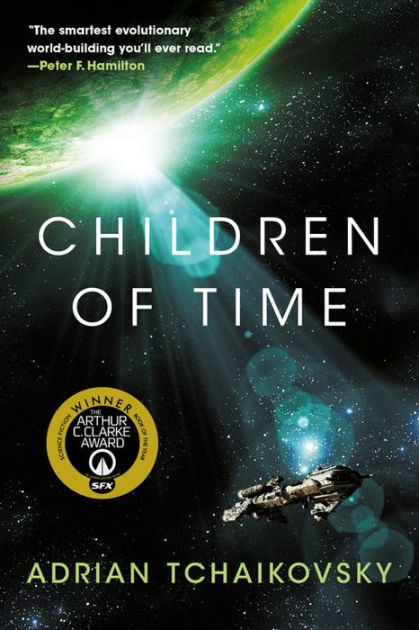
Children of Time

Children of Time by Adrian Tchaikovsky is the first in a space opera trilogy.

One civilization of humanity has extended out into the universe to find other planets that maybe a replacement for earth. Some they will terraform, and on one likely candidate they will seed a new strain of humans. This involves transporting monkeys and putting them on this planet (cleansed of all other mammals) along with a nanovirus that will speed up their evolution. One person will be left in stasis in orbit, in a satellite cum lifeboat, to communicate with the new species. However, some members of this civilization think this is wrong and the operation is sabotaged, leading to the death of all the monkeys and the chief scientist and architect of the plan being the one that ends up in stasis.

The virus survives on the planet and, as it doesn’t have any monkeys to infect, lodges itself in whatever it can find. In one species of spider it finds a host that it can evolve and the novel traces this evolution over millennia from primitive hunting spiders through the development of farming and use of tools to a sophisticated society capable of leaving their planet.

In the meantime, the human civilization responsible collapses and new civilizations emerge. One of these, on an earth now dying, launches generation ships loaded with colonisers looking for new homes. They stumble on the spiders’ planet which seems perfect. But the scientist in orbit above the planet, now almost completely fused with the AI, mad with isolation, and unaware that the monkeys didn’t make it, drives them away. Centuries later, the generation ship returns in desperation: no other possible homes have been found. By this time, the spiders are space-going and have brought the scientist/AI down to live with them.

I really enjoyed Children of Time. I loved the evolution of the spiders and how that was determined by their methods of communication and what is available to them. They develop sophisticated technology based on bio-chemistry and not on metals. It’s marvellous – although probably not for those with even mild arachnophobia. I found it quite hard to put down. I’m looking forward to book two.

Object in Focus: The Lewis Chessmen

I’ve never paid much attention to the Lewis Chessmen, despite their prominence in British Museum gift shops. However, one of my reading quests is to read all the books in the Objects in Focus series, so here we are.

The Lewis Chessmen, by James Robinson, takes an in-depth look at both the chessmen themselves and the intriguing story of what happened after they were discovered in the early 19th century.

There are enough of the chessmen to indicate at least four (incomplete) sets, but there is also some indication that individual pieces were sold off before the hoard left the isle of Lewis and came on to the antiquities market. How and exactly where the hoard was found is shrouded in some mystery and the book examines the gaps in the stories, the rumours, and the possible events that might explain what happened.

The chessmen are made from walrus ivory and the book looks at the difference between walrus and elephant ivory and what that means for craftwork. It also explains the economics behind using walrus ivory, a more difficult material to work. Examining the styles of clothing the chessmen wear and the motifs on the thrones of the kings and queens show that the chessmen were likely made in Scandinavia in the 12th century. And finally. the book takes a look at the history and spread of the game of chess.

These little books are always a delight and this one was surprisingly engaging.