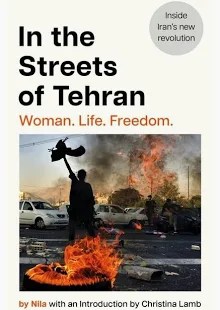
In the Streets of Tehran is a short book describing the daily activism of a woman living in Iran and fighting for women’s rights. The author is Nila, a pseudonym to protect her identity and the book was translated from Persian by Poupeh Missaghi.
In 2022, following the murder of Mahsa-Jina Amini, protests started in Iran, chanting the slogan Woman. Life. Freedom. These are the most widespread and largest protests in Iran since the Islamic Revolution in 1979. The book documents the daily acts of protest taken by one woman and shows a reality that news media just can’t adequately convey.
Iran has a young population – 60% of the people are under 30 – but the protesters are not just young people, they are also the generation that lived through the revolution in 1979 and the repression that followed. In short, elegantly crafted snippets Nila presents the daily experience of protesting, putting her body and life at risk every single time. It is a sobering counterpart to the restrictions on the right to protest in the UK. This is where that trajectory will take us.
The book also manages to tell us not just what life is like in Iran right now, but gives us a picture of a broader culture and some of the history of the country. Nila is inspired by Táhirih, a 19th century poet, scholar and women’s rights activist. Today’s protests are built on a movement that stretches back far into the past. They are also inhibited by more recent history, by the belief common to Iranians that the West is the arbiter of their destiny, a belief based on the realities of UK and US intervention in Iranian politics since the end of World War II.
It is a very moving book, telling some shocking events and horrible situations that have become normal, like the way that the state murders a person and then makes them pay to retrieve the body and pay for the bullets that killed them. Sometimes the community raises the money collectively. One situation, that I would not have thought about otherwise, is how intermittent access to the internet is weaponized. People in Iran can access the internet and they use it to get news, both about Iran and the rest of the world, but then when that access is unreliable they are left with the emotional impact of learning about the occurrence of tragedy and no way to find out about the resolution. Spending time trying to find a VPN that works or checking if access is temporarily available sucks up emotional and psychological energy and grinds people down.
In the Streets of Tehran is an act of bearing witness to the trauma of a nation. It is beautifully written with an elegant, concise style, that draws you into this world and makes you see what is happening here. This is an important book that deserves to be widely read.


Leave a Reply