Archives

100 Books in 2011 review: The Number of the Beast

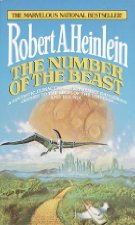
The Number of the Beast by Robert A. Heinlein is one of his later novels (published in 1980) and is not just a story.

The basic plotline is two couples in a time machine travelling through a series of universes, more or less similar to our own, alternately running from and chasing the villains that tried to kill them at the start of the story.

But what it really is, is a homage to 1930s pulp science fiction. The style is dated and the characters are Heinlein usual combination of intellectual brilliance, excessive heteronormative sexuality and stereotypical gender norms. Interestingly, Heinlein spends some time exploring the unconscious ways in which men undermine women’s assertion of equal rights and self-determination while believing that they are being supportive. It is surprisingly insightful, given Heinlein’s justified reputation for reactionary thinking.

The book is full of in-jokes, most of which I didn’t get, not being steeped in the fiction which the book is paying homage to. I liked the concept of fictons – that somewhere in the multiverse any fictional world thought of pops into existence. That would be cool. Of course, Lilliput, Barsoom, Oz and Wonderland wouldn’t be the worlds I’d choose to visit but there you go.

I hated the ending where Heinlein brings all his characters together for a big, self-congratulatory conference. This is strictly one for the fans.

So, if you could visit any fictional world/universe where would you choose to go? I’d go to Sunnydale, Westeros and the Culture.

100 Books in 2011 review: Edge

I was looking forward to reading Edge by Thomas Blackthorne. I liked the blurb (which you can see in the picture). It sounded like it was going to be an ultra-violent Running Man fun type of silliness. Predators in book form. But that’s not what it was. Bad Angry Robot. That’s the second time I’ve read a book from this imprint that did not contain what was on the label.

Edge is actually a thriller set in a near-future dystopia. The son of a wealthy and influential tycoon runs away from home so he hires an ex-SAS soldier with mad software skills to find the boy. Doing so reveals illegal activity on the behalf of the tycoon’s biggest rival in cahoots with a corrupt government. It’s set in a near-future UK where everything is tracked and recorded electronically all the time and getting off the grid is tough. Knife duels are legal and as a result crime is down but loads of people die in duels. And sports/reality TV is dominated by a duelling league where combatants die every week for your viewing pleasure. But the book doesn’t focus on that part of it. That’s the backdrop for the real story.

It was a good thriller. It was easy reading and fast paced. The protagonist, Josh Cumberland, is a fairly typical modern thriller hero; big, buff, beautiful, with special forces training (which in this world includes cyber warfare) and an anger management problem. What lifts Edge up from the mass is the cast of strong female characters that support the protagonist. Cumberland’s team of ex-SAS buddies are not all male – and the ones that are, have three-dimensional personalities. His insider on the force is a policewoman who gives free self-defence classes in her spare time. The ‘love interest’ is a psychologist whose skills are pivotal to resolving the central mystery. And it’s nice that her role as psychologist way overshadows her role as love interest. I thought the characterisation was real and sensitive, and I think this might actually pass the Bechdel test.

The near-future setting was rich and cleverly put together. It was distinctive, memorable and thoroughly thought through, and yet at no time did the setting overshadow the story. I was disappointed that the knife duelling reality show didn’t have more airtime, but that’s only because that’s what I thought the book would be about. But Edge is excellent, and it was a better story than that. I hope Blackthorne writes more stories set in this world.

Writing-wise, it was clean and competent. Blackthorne has a very understated style. The writing focusses on plot with description and characterisation subtly woven in-between dialogue and action. Ignore the blurb and give it a go.   

100 Books in 2011 review: Grass

Book number 1 in the 100 books in 2011 challenge is Grass by Sherri Tepper. It’s number 48 on the SF Masterworks list. The blurb says:

Generations ago, humans fled to the cosmic anomaly known as Grass. But before humanity arrived, another species had already claimed Grass for its own. It too had developed a culture… Now a deadly plague is spreading across the stars, leaving no planet untouched, save for Grass. But the secret of the planet’s immunity hides a truth so shattering it could mean the end of life itself.

Grass follows Marjorie Yrarier and her family as they go as ambassadors to Grass with the secret mission of finding a cure for the plague. There are two societies on Grass; the aristocrats, an ossified relic of old European aristocracy that spends its time hunting; and the Commons which is a vibrant, trading nation. Then there are the Hippae, who act as mounts in the aristocrats’ hunts, but who are far more than semi-intelligent animals.

I loved this. The central mystery is well-handled and the reveal is done slowly over the last third of the book. Grass as a world is vividly realised and it’s inhabitants and their relationships are well-drawn. The ideas about social organization are subtly woven in and the plot is always at the foreground. I actually couldn’t put it down. It’s nice to read something with a middle aged woman as the protagonist – especially science fiction, especially an adventure mystery. Marjorie is a wife and a mother, and yet she is portrayed as an individual, as active and as as driving the story. Marjorie is purposeful woman, driven to solve the mystery at the heart of the disturbing planet she finds herself on and, although she has love interests (three if you count her husband) they are secondary to the main plot. It’s worth mentioning because it strikes me that female protagonists, in this type of story, are pretty rare. Tepper avoids the traps of either making her female protag solely defined by her family and romantic relationships or making her a man in a lady costume. It’s so refreshing.

I only have two minor niggles, and seriously, they are tiny. First. the planet Grass is sharply drawn and the word picture is rich and vivid. The group of colonies that it is part of is quite fuzzy; I don’t even know whether to call it a galaxy, system or universe. Perhaps it doesn’t matter as most of the action is on Grass but it does feel slightly incomplete. The other niggle is the omniscient third person POV. Tepper handles it well so it doesn’t feel like head-hopping, but I did find it a little old-fashioned and in one or two places it is confusing.

So, Grass was excellent, overall. It was complex, deep and thought-provoking. It was beautifully written. It made me want to read everything else she’s written. Highly recommended.

Thoughts on reading: Matter

This is not one of 2011’s 100 books. I read this last year and I’m a little behind in my thoughts on reading posts.

I’m a huge fan of Iain M. Banks. I think his science fiction is way better than his mainstream stuff (which I do still enjoy). Matter simply confirmed that for me. I loved it. It is a Culture novel that starts of in a world in another civilization’s sphere of influence that has not developed space technology of it’s own. This part of the story is more of a mediaeval fantasy. One of the main characters has left this world to join the Culture and decides to return on hearing of her father’s assasination, where she discovers interference by other civilizations and her trip turns into a Special Circumstances mission.

The scope and detail of the novel are vast and intricate. I don’t know how I would be able to keep hold of all that information while writing. Banks is pretty much good at all the elements of writing. The characters are great with fantastic names. The dialogue is excellent. Story structure is good. The mystery at the centre of the novel was handled really well; it was clear that things were not as they seemed, would not work out the way the characters believed they would, but it was not obvious what would happen. Happily, I didn’t get the surprise but when it was revealed I was ‘oh yes, of course’, which is how I like it.

The ending was amazing. It was Shakespearean in it’s death-toll and I was gripped. It was completely absorbing. This is one of my favourite books of 2010 and you must read it!

Thoughts on reading: Selling Out

I have a huge stack of books I’ve read waiting for blog posts. Some seem like much harder work than others. Selling Out by Justina Robson is one of the easy ones.

This is book two in the Quantum Gravity series, and this time I’ve actually read the first one. What I love about this is the blend of science fiction and fantasy. It’s set in the near-future after a world-changing event, the nature of which is not clear at this point. The protagonist is an experimental cyborg spy who is sent on missions to the new worlds (elf, fairy, demon, etc) that were revealed by the event. I’m all for a bit of genre-bending and Robson is a great writer so it all comes together seamlessly.

When I read the first book I thought it was fun and well-written but lacking the depth and complexity of Living Next Door to the God of Love, which was the first of Robson’s novels that I read. After reading Selling Out I think I might be wrong. It’s still great fun, and still has a light feel to it, but the character development and foreshadowing in this book make me suspect that by the time I get to the end of the series a grand vision will have been realised.

In this book, I noticed how the dialogue stood out. It worked hard to move the plot along and reveal character. It’s snappy, witty and highly engaging.

Justina Robson is one of my favourite authors and I can’t wait to read the rest of the series. And everything else she’s written.

Misfits

Is anybody else loving Misfits? I think it’s the best new sci-fi on the telly for ages. Can’t wait for series 3 next year!

Thoughts on reading: Non-Stop

Number 33 of the SF Masterworks is Non-Stop by Brian Aldiss, which deals with the generation-ship vision of spaceflight. As I’m doing with the Fantasy Masterworks, I’m sort of making my way through the SF Masterworks as well. So far, I’ve read 2, 4, 43, 46, 52, 53, 60, 61, and 67.

I enjoyed this. The worldbuilding is good and there is a mystery that builds up to an excellent reveal. What I noted particularly about the writing was the use of language. Aldiss uses words that indicate one thing to the reader and manages to convey that the characters of the story understand something else by them, for example, ponics (the crop the characters harvest) and ship-related words. There’s a lovely point at the end where the main character, Roy, sees the sun for the first time and says he imagined it square because the lights on the ship were all square. Having said that, sometimes, often enough for it to be noticeable, Aldiss uses cliches and adages that are too contemporary and it jolts the reader out of his world. So, I found use of language both good and bad in this book.

Ways of Seeing by John Berger is a book based on a 1970s TV series of the same name, examining the role of the observer in studying art and the myth and meaning of oil painting in Western culture. Fascinating, thought-provoking and challenging. The ideas in this book really excited me. Recommended!

Thoughts on reading: Black Man

I read a lot and as I’ve got better at writing (and more confident in my writing), most of what I read either makes me feel ‘I can do this too’ or ‘That’s a good way of doing it’. Occasionally, I read something that makes me feel talentless and stupid, that makes me realise how big the gap is between where I am and where I want to be. Richard Morgan’s Black Man is one of those books. It was amazing.

Something about this book made it seem better than everything I’ve read in a long time. All the basics are there and are done well. It’s a great plot, with twists and turns but no cheats. There are two key moments where I wasn’t sure what was going to happen next (in a good way) and in the end everything came together to create a full understanding of what had happened. The plot was really strong and well paced.

Worldbuilding is something I particularly noted. Morgan throws the reader into his world immediately and just leaves them to catch up. It’s slick and realistic. I don’t know if it’s just that I haven’t read much new science fiction lately, but it seemed really modern. It seemed like Morgan is really up on current affairs, cutting edge science and social/psychological theory and his vision of the future jumps off from now. He has lots of little details that really ground the book and make it real, such as having the characters reference celebrities, music, intellectuals and gurus. My over-riding impression was that this was a really intelligent, thorough book.

The characters were well-drawn, believable, with deep inner worlds and congruent outer actions. It was all done through inner monologue, for the POV characters, dialogue and action. The action scenes were exciting, convincing and pacy.

It’s not perfect. I noticed one or two clunky adjectives and awkward turns of phrase but that was all in a 600+ page book. I think that what makes this work so well is that all the elements are done to a high standard. There are many enjoyable books that have good plots with ok characters, or great writing and weak plots, or fascinating characters with nothing to do. Few books get everything right, and this is one of them. And on top of that, the themes are intelligently thought through in a fascinating way. Read it. It’s amazing.

In non-fiction news, I read The Courtesans by Joanna Richardson, which is a book of short biographies of 19th century French courtesans. Interesting, and full of tidbits for the work-in-progress!

Reflections on alt.fiction 2010

Wow, what a difference two years makes. I’ve just got back from alt.fiction 2010 and it was thought-provoking and inspiring.

I went to alt.fiction 2008 and it was a fun event. I met some people and learnt some things about writing and getting published, but it wasn’t such an amazing experience that I was keen to come back again. The organisation and sessions had an amateurism that doesn’t appeal to me. I have some experience in professional event organisation, which may make me harsher than others, and the little things are important to the overall impression of the day. We all have our quirks, right?

2009 didn’t happen. I know what the reasons were; I think it had to do with funding and logistical support. Given an extra year, and the fact that I have friends in Derby, I thought it would be fun to go again. I wasn’t expecting too much.

This time round both the organisation and panels were better. The event seemed smoother and there were plenty of helpful staff on hand to keep things under control. The panellists (many of whom were the same as 2008) stepped up to the smarter venue and better organisation. The disucssions were erudite and intelligent and I was inspired by the conversations. It reminded me that there’s nothing that’s more fun than talking about books and writing, especially specultative fiction.

I couldn’t attend every session. From what I did attend, this is what I’m taking away with me:

  • Writing can be a career. You have to decide what you want from it and treat it in the same way you would any other career.
  • A web presence is essential.
  • Chasing the market doesn’t work. Write what you need to write – the market will catch up with you.
  • I have so much reading to do…

I’m definitely going next year. Maybe by then I’ll have worked up the courage to talk to a publisher about my novel.

The Left Hand of Darkness

I put The Left Hand of Darkness by Ursula Le Guin up for my book club to read. There was a point before I’d read it where I was getting worried that it would be really hard going, because two people had given up on it only a few pages in.

But I have two hours of commute and I was determined to see it through to the end. As I am quite interested in gender representations in literature and keen to avoid problematic stereotypes in my own writing, I felt that this was an important book to read. Le Guin sends a male protagonist, Genly Ai, as an ambassador to a world in which people are not defined by gender. Each person has a monthly cycle in which they are sexually active for about a quarter of the time and pairings change into male/female pairings depending on the interaction of hormones between them. Every person will be male sometimes and every person will be female sometimes. Every person will be both father and mother.

The first third of the book is hard going. There is fantastic depth to Le Guin’s worldbuilding and there’s a lot to take in. The narrator of this section, Genly Ai, is also highly unreliable, although that doesn’t become clear until later in the book. While reading it I was disturbed by the judgements Ai was making, in particular the negative qualities he clearly identified with the female. The book was written in the late sixties and reflects a very stark correlation of masculinity and positivity. I’d like to think that is less true today, but perhaps it’s just less boldly stated.

Anyway, the world that Ai is visiting is split into nations and there comes a point at which Ai goes to another nation. Here the book changes. Another character, Estraven, becomes a POV character. Through Estraven’s eyes we see things differently and realise just how unreliable Ai is as a narrator. The pace of the story picks up and in the last half is quite the adventure story.

I was awed by Le Guin’s worldbuilding. Her world is worked up from the bottom meaning that everything is different and new and we can’t make any assumptions. After having read so many fantasies lately where the worldbuilding has been quite superficial, this was both inspiring and intimidating! The writing is wonderful; I really enjoyed the lush, detailed language. The characterisation is subtle and effective. If was going to make any criticism it would be that the various voices could be more differentiated, but it’s a tiny point. The Left Hand of Darkness is amazing; go and read it now.

For non-fiction I read A History of the World in Six Glasses by Tom Standage, which looks at beer, wine, spirits, coffee, tea and cola and their impact on society. It was entertaining, easy to read, and offered a unique way of looking at history. I learnt stuff I didn’t know before which is really what I’m looking for.