The Bees

BeesI love my kindle. It’s much better not having to carry around several books and I run out of something to read much less frequently. I still read and buy physical books but I don’t think reading on the kindle is a less rich experience. The one downside of the kindle, though, is I can’t see what other people are reading. Maybe a display panel could be added to the back, because I quite often read books that I’ve seen people reading on the train.

The Bees, by Laline Paull, is one of those books. It’s about a swarm of bees and describes a cycle of their lives. It’s told from the point of view of Flora 717, a worker bee who is able to transcend the bees’ caste system and take on several roles from nursery nurse to forager.

Paull’s world is based on some facts about bees but is essentially magical realist in tone. The bees are anthropomorphised and the hive is turned into a golden palace. It does require some suspension of disbelief but if you’re prepared to give yourself over to this world it is truly lovely.

In order to relate the events of the book, Flora has to be able to move out of the caste she’s born into and this is unusual. Most bees have their role and stick to it. Except foragers. Any bee can become a forager. But Flora is special and only she can save the hive. Flora isn’t so much a character as a device, but for this type of novel, it works. It’s not perfect, and the lack of any real danger to Flora lets the book down in a couple of places. Point of view slips towards the end and an authorial voice intrudes.

I didn’t like the prologue and epilogue which offer a human view of the hive. The book would have been better without them, and the epilogue in particular was overly sentimental.

I enjoyed the world-building. I was completely sucked into the book and found it beautiful, lovely, and captivating. Paull evokes both devotion and menace very well.

There are some weaknesses to the book but, overall, I enjoyed it. It’s unusual, and what’s good is really good. And there’s a happy ending, which was the perfect choice.
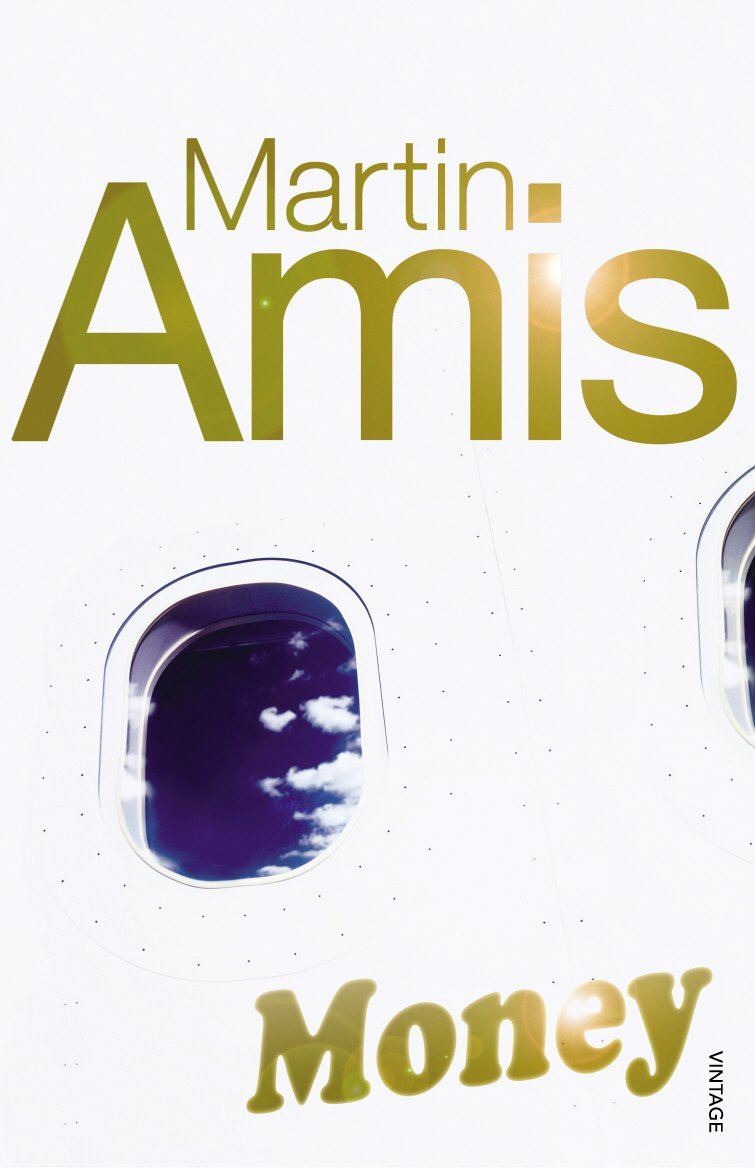
Money

A little while agomoney I decided I didn’t want to write any more reviews of books I didn’t enjoy. There are two reasons for this. First, I don’t like doing it, the posts are hard to write, I don’t want to be negative, and I believe that if you can’t say something nice don’t say anything at all. Secondly, the purpose of this blog isn’t to provide a buyer’s guide to books; I started it as part of learning to write myself and to capture what I learn from reading.

I was a bit conflicted about whether I should review Money by Martin Amis because, in the end, I didn’t like it, but, I read it for reasons that have to do with learning to write. In May I went on an Arvon Foundation course. Throughout the course the tutors referred to books and writers that they felt we could learn from, and they stressed the importance of reading for writers. I came away with quite a list. Several of Martin Amis’ books were mentioned and, given I’m not a fan of literary fiction, this one had a subject that I thought I’d find interesting. So, here we go.

Money is an exercise in voice. John Self, the first person narrator, is a wild, chaotic character who consumes too much of everything at breakneck speed in order to avoid confronting the soullessness of his life. The voice is full of slang and is witty and entertaining. I enjoyed it a lot. The worldbuilding experience is similar to that you get with science fiction and fantasy where you’re not quite sure what all the words mean but the cumulative effect creates a fantastical world. Amis very cleverly conveys that there is much more going on than John Self realises. The characters are well-drawn and believable, even the most outrageous depictions of the celebrities. But the pace and wit of the start of the book aren’t maintained. I suspect that is done deliberately, but as the voice became more sober I became less engaged.

There is a character in the story called Martin Amis, a writer, and I found those sections jarring. It’s not just the name. The dialogue of that character and his relationship with John Self don’t feel as true as the rest of the book. It’s self-conscious and pompous. I found it bounced me out of the storyworld.

The plot is that John Self is an ad director who has been offered backing for a film. There is apparently a lot of money flying about, big stars, lots of investment, and the producer, Fielding Goodney, encourages John to live the high life. There’s some blackouts – John Self is a convincing alcoholic – some events he doesn’t remember, some clues that all is not right but John is not capable of recognising them. It’s a scam. I won’t reveal the twist, such as it is, but you’ll see it coming in plenty of time. The Martin Amis character is used as a mouthpiece for explaining the plot at the end. Normally, I don’t like that, but I was left with a feeling of ‘is that it?’ so I was reading on in case there was more to it than I’d realised. There wasn’t.

The ending of the book was disappointing. On the course one of the tutors said that story is about change in the protagonist’s feeling. That does happen, but the change is small and the book is long, and it’s not very satisfying. I felt cheated. There was a lot I liked about Money and I enjoyed at least the first half of the book. The characterization and voice were excellent, I loved the language, it was witty, and I liked the pace. It is skillfully done. On the other hand, the ending was a let down, I felt nothing had really happened (although there’s more plot than that suggests), and it became less engaging in the second half. The irritation of the Amis character contributed to this. And this book will end up in the pile of ‘reasons I don’t like literary fiction’.


Fenrir

fenrirFenrir by M.D. Lachlan is the sequel to Wolfsangel and is really the same story. I’ll explain what I mean in a moment.

In Fenrir, a merchant is sent to bring a French noblewoman from Paris to Rus king Helgi because there is a prophecy that Odin will manifest on earth and trigger Ragnarok. The characters from Wolfsangel (Valli, Feilig and Adisla) are reincarnated in the characters in Fenrir, along with Odin and Fenrir, and it is not clear who is who. The merchant is accompanied by a mysterious warrior to protect him, as he is not the only one seeking Aelis, the noblewoman. The Vikings beseiging Paris also want her, as do two Viking shamans.

Aelis has her own ideas about this, which is nice to see, and takes charge of her own destiny in a way that feels consistent with her Christianity and the early medieval setting. It’s a gripe of mine that writing good female characters in historical settings means giving them modern sensibilities rather than fully embodying that character in time and space.

The characters are variously working for or against the manifestation of Odin and Fenrir, sometimes both. Lachlan manages to effectively convey a sense of confusion. None of the actors is sure what it is they are supposed to do and are wary of inadvertently bringing about the thing they seek to prevent.

Fenrir has a different style to Wolfsangel. Initially, I missed the lyricism and the mystical atmosphere of Wolfsangel, but I was soon drawn into the story. The change in style reflects the change in setting and underlines that this is the second cycle of the myth. It is the same, but not the same. In the end, Ragnarok is averted, but Odin and Fenrir will continue to try to manifest and the story will play out over and over again, until one day they meet and the end of the world begins. I enjoyed this and I’m looking forward to reading the next two cycles.

Honourable Friends

Honorable friendsHonourable Friends by Caroline Lucas is a tour through her experience as a Green Party MP over the last five years and a look at the work she’s tried to progress.

Part of the book describes what it was like to enter Westminster when Lucas was first elected, with no party machinery in place to support her and no experience of the strange traditions of the place. Part of the book is a discussion about the change Lucas wants to see in both policy and procedure. A chapter is devoted to subjects like the environment, the NHS, housing and foreign policy. Lucas describes how she’s worked to find support from MPs in all parties and where she’s succeeded or failed. She points out how some of the ‘quaint’ archaic traditions of the British parliament hold back progress and block democracy. For example, Lucas talks about how voting works and how the process gets in the way of MPs giving votes serious consideration, or about how MPs are appointed to committees or reviews and how knowledge and experience is seen as unnecessary.

The book has a tone of ‘if people could just see how dangerous these policies are, they’d all change their minds’, a kind of bafflement that anyone could think austerity was a good idea. I’m not sure it’s a sophisticated persuasion technique, but I suspect Lucas is preaching to the converted with this book.

If you’re interested in the mechanics of how politics is done in the UK, or how democracy is expanded or contracted, then there is a lot of detail in here. Lucas’ style is conversational and it’s an easy read. I enjoyed it.

The Establishment

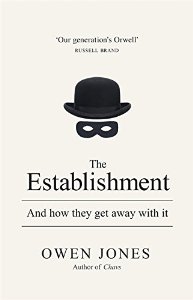
Establishment  In The Establishment, Owen Jones argues that the establishment is not so much a group of wealthy people in cahoots to keep everyone else down, but rather a collection of people with shared beliefs who benefit from being able to influence each other.

The establishment hasn’t remained stable over the years and those that are considered to make up today’s establishment are not the same as those following WWII. To start with Jones charts the shift in the political consensus from the 1940s to now. Once upon a time, free market ideology was fringe thinking and considered a bit barmy. Jones shows the methods by which more and more influential people were convinced by it’s proponents. It shows how money can be used to change people’s thinking. There are lessons there for those who wish to shift the political consensus back towards the centre, but the lesson is that money speaks and money corrupts.

Jones looks at each of the groups whose members make up the establishment and shows how their interests align and complement those of the other groups. The chapter on tax avoiders was particularly illuminating. The involvement of corporations and huge consultancies in the process of writing legislation and regulation enables those corporations to manipulate the system in their favour. The revolving door between politics and business has serious implications for democracy. To be clear, Jones never claims this is a conspiracy. There’s no group of people sitting in a room somewhere cackling and stroking white cats. Much of this is the unintended and unexamined consequences of people pursuing their own interests.

I found the discussion about ownership of the media and their relationship with their readers interesting. Papers don’t report what they think their readers want. They report what their owners and advertisers want. He shows (and he’s not the first) how the pressure to maximize profit compromises investigative journalism.

The Establishment is a dense and lengthy read. I found it thought-provoking and stimulating and would recommend it to anyone interested in how politics works.

The Handmaid’s Tale

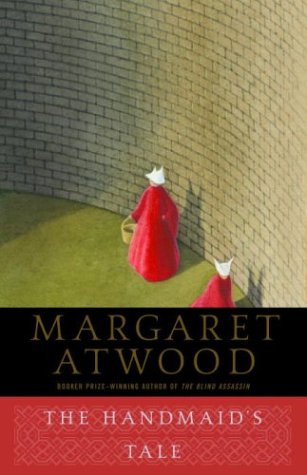
handmaid's taleHow have I waited so long to read The Handmaid’s Tale by Margaret Atwood? It’s a classic, and has been televised, and is the kind of thing that sometimes you don’t read because you think you know all you need to about it. The Handmaid’s Tale was published in 1985 and I really should have read it long ago.

Sometime in the 20th century a Christian extremist sect sets up a totalitarian theocracy in the US. The handmaids are a caste of women able to have children which is now a rare ability, due to widespread sterility. It’s not clear if that because of environmental toxins or out-of-control STDs. Offred doesn’t know what’s true and what isn’t, so neither does the reader. The ruling elite use propaganda to create the beliefs they want the populace to have, and much of what the narrator, Offred, relates is what she’s been encouraged to believe. The parallels between that and the distortion of reality created in today’s media are striking.

Offred describes her life, her illegal relationships with the Commander and his driver, Nick, and her eventual escape via an underground railroad. It is compelling. The claustrophobic nightmare of Offred’s life is vivid. What struck me the most was the boredom. Offred has nothing to do. People are not permitted to read or to write and a handmaid’s only role is to breed. Offred is allowed a daily trip to obtain rationed food but she has no other role, so she spends a lot of time on her own in her room doing nothing. There are exercises and prayers but Offred is not a true believer.

I was gripped by the story. I’d expected, as it was published in 1985, to find it dated. Scarily, the opposite was true. It seems like a future that is only a couple of steps away. One or two wrong turns and we could easily end up there. Atwood’s realisation of the impact of living in a totalitarian society is chilling. It’s an important book and is still relevant. If you haven’t read it yet, don’t wait any longer.

——

Buy my book Fragments at Amazon or Smashwords.

Half a King

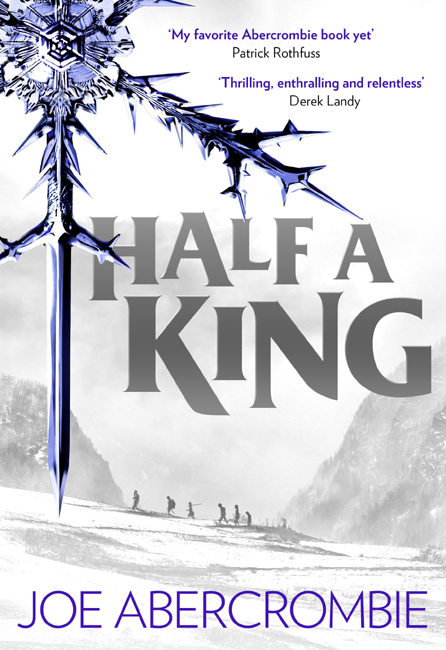
half-a-king-uk-hbHalf a King is Joe Abercrombie’s first YA novel and the first part of the Shattered Sea trilogy.

The protagonist is Prince Yarvi, who is studying to become a healer/priest/diplomat. He has a twisted hand which means he can’t wield a weapon, somewhat of a disadvantage in a medieval setting where might is right. But that’s ok, he’s the second son of the king and is free to use his brain instead.

Then Yarvi’s father and older brother are killed in an ambush and Yarvi’s life changes. He must assume the throne. He wrestles with his feelings of inadequacy and is beginning to come to terms with his new role when his uncle betrays him, usurps the throne and leaves him for dead.

Yarvi rashly swears an oath to avenge his father and regain his throne, but he has been captured and sold as a slave, so first he has to get free and get home.

I’m a fan of Joe Abercrombie and Half a King certainly confirmed that. I’m not a young adult so I don’t read YA novels often. I loved this and am eagerly awaiting the second in the series.

Yarvi is not an entirely likeable character. Throughout the book he learns his own strength and discovers that he can be a leader. He also learns how to be ruthless. He has some hard choices to make and sometimes there’s no good outcome whatever you do. This is a lot to put on young shoulders. Watching Yarvi’s growth is fascinating.

There are layers and layers of plot full of twists and betrayals. I’m impressed by the way every twist makes perfect sense within the story yet I was surprised by each one. It’s no mean feat.

The supporting characters are great and have real presence. Nothing is a favourite of mine. It was clear from the beginning that he was not what he seemed, but I was still surprised by the reveal at the end of the book.

I was a little disappointed by the small proportion of female characters in the book. Even given a medieval setting more could have been made of the ones that were there and there could have been more of them. I did like the discovery at the end of the book that the real reason for all these layers of betrayal was an attempt to neutralise a powerful female character, so there is hope that there will be greater balance in the sequels.

Overall, I loved it and would highly recommend it for adults of all ages.

——

Buy my book Fragments at Amazon or Smashwords.

Fragments is reviewed by /Garbage-File

I’m delighted that /Garbage-File has reviewed my collection of short stories, Fragments, and deemed it well worth your money. If you like psychological horror that is gore-free but leaves you feeling decidedly uncomfortable, then this is for you.

My favourite bit was when the reviewer described one of my stories as ‘car-crash reading’. 🙂

It’s available for about £1 from Amazon or Smashwords.

Fragments now available as an e-book

Fragments coverFragments is a collection of deliciously disturbing tales of psychological horror, featuring ghosts, supernatural creatures, and most terrifying of all, humans.

Fragments is now available via Amazon for the Kindle or via Smashwords for all e-reader formats.

C.R. Smith and I published Fragments a couple of years ago but originally it was only available on DriveThru.com as a .pdf. Not the best format for reading stories, especially ones so creepy you’ll need to be safely tucked up in bed, so we’ve created it in as many formats as we can.

If you read it, I’d love to hear your comments. Leave me a review where you purchased it, or a reply on this blog.

The Book of You


bookofyou

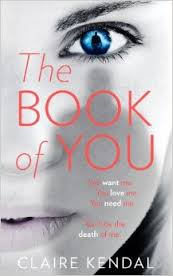
The Book of You is Claire Kendal’s debut novel. I picked it up as an impulse buy in a newsagent in an airport, drawn by the title, and then by the blurb on the back.

Clarissa Bourn is being harassed at work. Rafe wants to be in her life and won’t take no for an answer. She tries to be polite and nice, like she was brought up to be, but he doesn’t seem to be getting the message. Then Clarissa gets called for jury service and thinks that she will have a break from Rafe, The trial is going to be seven weeks long. Having called 999 on a previous occasion, Clarissa is reluctant to go to the police. After all, what has he actually done? She has leaflets on stalking, yet can’t quite bring herself to acknowledge what is happening to her, can’t quite grasp that Rafe won’t respond like a normal person.

The trial is not the respite she hoped for. Rafe continues to follow her, contact her, harass her. And the trial is of five men accused of abducting and gang raping a drug addicted woman who has sold sex to pay for her drugs. What people say about the victim underlines and reinforces Clarissa’s own shame, yet she sticks to the advice in the leaflets, even when Rafe’s actions escalate.

This book is fantastic. Kendal captures the shame, self-blame, anxiety and bafflement felt by victims of sexual harassment and stalking. Clarissa can’t understand why this is happening and believes it must be something about her that has caused it. She’s ashamed of her behaviour and believes people will judge her. It takes a long time for her to grasp that this is about what’s wrong with Rafe. I particularly enjoyed the way Kendal has captured the effects of prolonged anxiety and stress on Clarissa’s body and mind, the way the constant alertness, feeling trapped, being suspicious of everyone and everything, grinds a person down. This is an exceptional study of what it’s like to be stalked. There’s a lot in the book about the way women are treated by society, especially how evidence of any sexual activity is used to diminish and punish victims, and how they’re expected to respond with politeness, but it is all conveyed by the story and there is no sense of lecturing by the author. It is very skilfully handled.

I don’t want to give away the ending, but I do want to say something about it. Initially, I found it somewhat unsatisfying. There’s an expectation that this kind of book will go a certain way, so anything that’s different from that is surprising. I guess it shows how deeply ingrained those expectations are. The ending is uplifting. That’s not how it’s supposed to go. And, on reflection, I find that I like that.

The Book of You is very, very good. It is absorbing, claustrophobic, scary and compelling. It’s so good I’ve broken my six month blogging hiatus to write about it (and I’ve read a few good books lately). I’ll be looking out for Claire Kendal’s next one.