The Elegance of the Hedgehog

This is a funny little book and I’m not sure what it’s about. In The Elegance of the Hedgehog by Muriel Barbery (translated from French by Alison Anderson) a concierge, Renee, looks after an apartment building in Paris inhabited by very rich people.

Most of the people who live in the building don’t notice Renee unless they want something and even then they barely condescend to see her. She goes on with her life, reading about philosphy, art, science and anything else that attracts her sharp and broad mind. It suits her to be unseen and to keep her erudition, which she believes inappropriate to her class, to herself. Her best friend is Manuela, who cleans in some of the apartments.

One of the inhabitants of the building is Paloma, a little girl looking for meaning in life but too intelligent to be taken in by the meanings offered to her by her family and culture. Then an elderly resident dies and someone new moves in.  Kakuro immediately sees beyond Renee’s facade and gently pursues her.

It is an easy read and an absolute joy . The prose is elegant, the characters likeable, and the diversions on art and philosophy are interesting. But I’m not sure how well it works as a story. There is a reason beyond class that Renee doesn’t want to reveal her self-education but, while it is a perfectly good reason, it is dumped on the reader all in one go, late in the book. There’s no foreshadowing or hinting at a deeper fear of exposure. The feel of the book throughout is one of a very light touch, of delight in life in various ways and the tragic ending doesn’t quite work with it. I couldn’t accept the tragedy as presented and thus couldn’t be moved by it.

The Elegance of the Hedgehog tries to balance philosophical musing with telling a story. The musing is elegant and fascinating and works really well. The story suffers. But, I did enjoy it despite being frustrated by the ending. I would recommend it if you enjoy beautiful prose.

The Player of Games

The Player of Games by Iain M. Banks is the first of his science fiction novels that I read. At the end of last year I read two of his more recent ones that I was blown away by and wished I could nominate them for my book club. I couldn’t because we have a page length limit of about 600 pages and these two books were both well over that. So, I thought I would nominate The Player of Games which I first read more than ten years ago. I wondered if I would like as much now as I did then.

The Culture is a socialist utopia run by artificial intelligences where people can pursue any life they like. (I totally want to live in the Culture). There are a group of people and AIs who form Contact which is like the Culture’s diplomatic service and armed forces rolled into one. Within Contact is a more shadowy organisation called Special Circumstances. These are the groups that manage the Culture’s relationships with other civilizations. Gurgeh is a man who has spent his life mastering all the games there are to play and is acknowledged as one of the foremost gamers in the whole Culture.

Gurgeh is manipulated into travelling to Azad, a more barbaric civilization to play the game that rules their society. How competitors place in the game determines the positions they will hold in public life. Azad is a hierarchical society riven with inequity and they don’t believe anyone from outside Azad will stand a chance in the game. Naturally, Gurgeh does better than anyone expects and the stakes become very high.

One thing I do notice about Banks’ books is that they start slow and end with a bang. I enjoyed this greatly, but perhaps not as much as I did the first time around. The reason for that is that Banks’ later books are much better :-). There’s a nice amount of ambiguity about who is playing who and several games are being played at once. It’s a gentle introduction to the world of the Culture and the themes that Banks’ likes to explore with it. There’s only a low level of machines with personality disorders which is disappointing but despite that, I would highly recommend it.

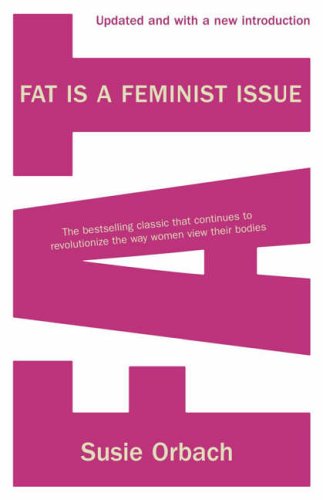
Fat is a Feminist Issue

Fat is a Feminist Issue by Susie Orbach is one of those books I should have read a long time ago, but didn’t get around to. It’s an experience akin to reading The Lord of the Rings, in that I’ve read lots of things derived from it so it seems quite familiar.

The central premise is that women’s relationship with their bodies is shaped by their experience of living in a male dominated society in which they are valued primarily for appearance. She is mainly talking about women living in rich, western countries, and acknowledges that she is not expressing a universal experience. Much of women’s energy centres around attempts to meet the beauty standard, which is currently to be very thin.

This has a number of effects including that women have disordered eating patterns and perceptions of their bodies. In terms of eating, if you have spent your life eating according to a diet plan, then eating when you’re hungry is not something you may be used to. The book talks about the associations women have with being fat or thin and both states of being have positive and negative connotations.

Much of this book is excellent. One thing that undermines the good stuff is that Orbach continually asserts that by learning to eat intuitively women will lose weight. This reinforces the message that losing weight is desirable rather than supporting the message that a healthy relationship with your body is more important than what it looks like.

If you’re interested in body issues and eating disorders this is essential reading.

Book trailers

Apparently books have trailers now. I’ve been aware of this for some time but never actually watched one, because it just seems like the wrong medium. Then I read that Joe Abercrombie’s forthcoming A Red Country has a trailer. I’m such a fangirl that, naturally, I went off to watch it. It still seems like an odd concept and I watched a few more to get a feel for them. I was looking for books or authors I knew and trying to avoid YA.

A Red Country, Joe Abercrombie: I will read this book, because I love his books, and I require no persuading. Having said that, if I was ambivalent I don’t think this trailer would sway me. It’s very much a mood film and gives away little in content.

Blue Remembered Earth, Alastair Reynolds: I’ve never read anything of his and never really been drawn to do so. Until now. The trailer was really intriguing and I will probably read this at some point.

Room, Emma Donoghue: This had been suggested for my work book club and rejected as nobody was particularly excited by the synopsis. Having seen the trailer I’ve changed my mind and I may well read this.

1Q84, Haruki Murakami: I’ve heard of the author but didn’t have an opinion about reading this book. I still don’t.

19 Minutes, Jodi Picoult: This is one of those authors that I’ve never read because I’m pretty certain their work is not my cup of tea. The trailer picqued my interest a bit but probably not enough to make me read this book.

A Most Wanted Man, John Le Carre: Based on the trailer, I wouldn’t read this, but if a film was made of it I’d want to see that.

Dark Prince, Christine Feehan: I have actually read this, well, two-thirds of it was all I could stomach. It’s paranormal romance, i.e. soft porn with vampires, and the trailer doesn’t deceive. My problem with the book wasn’t with the sexy parts (which were very good) but with the promotion of very conservative gender roles and relationships. If I hadn’t read it, the trailer wouldn’t have persuaded me.

Black Prism, Brent Weeks: This was the most filmic of all the trailers and I was tending towards thinking I might read it. Then I read some of the comments saying that the trailer completely misrepresents the book and that was the convincer. I will read the book now, just so I can see how far off the mark the trailer was.

All of the above are trailers for traditionally published books with a marketing budget. For comparison, I also looked at a trailer produced by Dawn Cartwright for her self-published short story collection, Son of Jack. I know Dawn through my local writers’ circle but I haven’t read the stories. It wouldn’t necessarily convince me to buy the book, although I thought that the gap between her trailer and some of the professionally produced one was pretty small.

I noticed that I tended not to like the trailers that featured the author talking about the book and prefered the ones that tried to bring you into the story world. On balance, I’m not sure trailers are going to add much to my book-buying decision making. Maybe I’m being a bit of a stick-in-the-mud. What do you think?

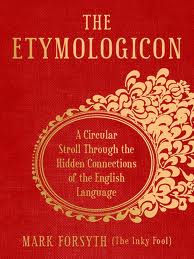
The Etymologicon

As read by Hugh Dennis on Radio 4! I caught the last episode over Christmas and it was funny, and available for 99p for my new kindle, so I bought The Etymologicon by Mark Forsyth. Who also blogs over at The Inky Fool.

It is a series of brief chapters on the origin of words in English, where they come from and how they’re related. Or not, in the case of some sets of words that seem like they should be. It’s utterly delightful.

I’m a word nerd. I love words, I love finding out where words come from and tracing the changes in meaning. I love how versatile and adaptable the English language is. So, there’s pretty much no way I wasn’t going to like this book, but I found I enjoyed it even more than I thought I would.

It’s funny, engaging and covers words that don’t ordinarily appear in this sort of thing. I spent a lot of time smiling when I was reading it and laughed out loud several times. I highly recommend it!

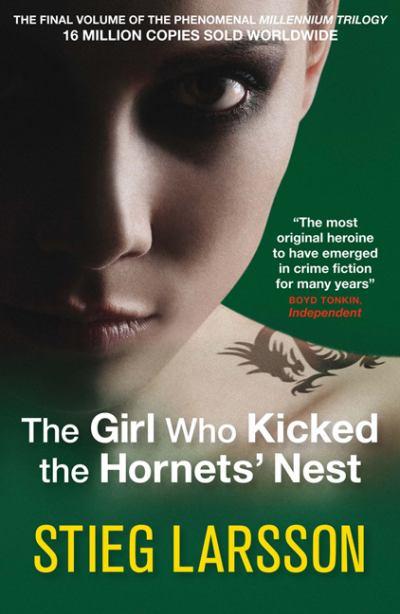
The Girl Who Kicked the Hornets’ Nest

Finally, the last part of the Millenium trilogy! In Steig Larsson’s The Girl Who Kicked the Hornets’ Nest, Lisbeth Salander is arrested for the attempted murder of her father and her friends work hard to save her.

Lisbeth has a bullet lodged in her brain and is taken to hospital where her life is saved but she finds herself under arrest. Blomkvist, Armansky and Bublanski’s team are working to find Niedermann and prove Salander innocent. Meanwhile the secret section within the Swedish security police realise that Zalachenko has created a huge problem and act to fix it.

I’ve found the previous two books patchy – there’s a lot of good points and one or two bad points. Given that, this book is surprisingly good. There’s less of the repetitive summing up that slows the story down and a lot of action. The two sides are trying block each other and Larsson weaves these threads together in a way that keeps the tension going throughout.

I particularly enjoyed the courtroom scenes. Larsson’s dialogue often sounds like the characters are reading reports to each other. I don’t know if that’s due to the translation or if the dialogue is just clunky. However, the dialogue in the courtroom scenes (which are mostly dialogue) really works. They are tense, emotional and gripping.

The story is resolved in a satisfying way. The baddies get their come-uppance but the good guys have to work really hard for it. And there is one point towards the end where Larsson pulls off a convincing threat to a main character.

I think I’ve enjoyed this book most of the three Millenium books and it lifts the trilogy as a whole.

Breaking News: I have published stories!

I’m so very excited. Fragments was published today and is available for download or as print-on-demand from DriveThruFiction.com.

Fragments is a collection of eight short stories of the macabre and creepy kind, of which I have contributed four. It is available to buy for 99p which is incredibly good value. The format is pdf which can be read on kindles or smartphones or ipads or laptops so you can read it on whatever device you like best.

Later in the week I’ll add a picture of the lovely cover art produced by my fellow contributor.

The Noonday Demon

I bought this book about ten years ago at a time when I was very depressed. It seemed like The Noonday Demon by Andrew Solomon might be relevant but actually I found it too upsetting to read.

The sub-title of the book is An Atlas of Depression. It starts with  the author’s own experience and an overview of depression in the US today. It is quite heavily focussed on the US but does occasionally talk about other parts of the world. Then Solomon covers current treatments for depression, how it appears in different populations, its relationship to addiction, poverty and suicide, attitudes to depression in history and current politics, and how it might fit with evolution.

Reading it at this stage in my life (I’m not currently depressed; episodes tend to be shorter and less severe; and I have an effective strategy for dealing with it), was easier in the sense that it wasn’t triggering, but it’s not an easy read. It’s full of fascinating facts, stories of the experiences of lots of people, and some interesting theories. I particularly liked the chapter on suicide and the revelation that feeling suicidal is not that well linked to being depressed.

The chapter on depression in history was also interesting – depression is not a modern problem – and gave some insight into how the attitude that depression is weakness of character has developed. I also liked that while this is hung around the story of the author’s experience he presents a wide range of other stories. Solomon looks at how behaviours such as aggression and violence might have a root in depression. The section on poverty has some thought-provoking ideas about how treating depression could have an impact on solving social problems.

What I didn’t like so much was what was missing. Somewhat inevitably, not every experience of depression is related here. While I found much that I could identify with, I didn’t find my experience. I’m one of those depressives that does a really good impression of not being depressed and while there were a couple of passing references to that experience, it isn’t given the same focus as other experiences such as being hopsitalised, or confined to bed for months at a time. Reading it now, that’s fine, but if I’d made it through the book the first time I’d have found that invalidating.

Another little niggle is that the author dismisses being a woman living in a male-dominated society as a cause of depression. As Solomon seems to be able to get his head around the concepts of internalized racism and homophobia, it is a little galling that he can’t extend that to internalized sexism.

However, these are small-ish points and I still found a great deal to enjoy in the book. If you live with depression, or are close to someone else who does, and are prepared for a moderately hard read, this book will provide a lot of insight. It’s not the whole story but it’s a good place to start.

Shadows of the Workhouse

The book for Book Club in March is Shadows of the Workhouse by Jennifer Worth, who also wrote Call The Midwife, now a BBC series. I know something about workhouses and the conditions that inmates experienced, the values that inspired them and some of the reasons why they didn’t work. I was interested in reading this but I didn’t pay too much attention beyond the title and I think this is another example where my expectations didn’t align with what the book is.

The first three chapters tell the stories of three people who grew up in workhouses, their experiences there and how it affected the rest of their lives. Then there is the story of the kleptomaniac nun . And lastly the long story of a lonely old man whom the author was friends with and who ended his days in a home in a building that used to be a workhouse.

While Jennifer Worth does give some background into the establishment of workhouses, which was very interesting, this is not a book that will tell you anything about the structure of a society that brought these places into being. Neither does it examine the legacy that the workhouse has left us, except in the most personal sense. Worth touches on the values and attitudes that create beliefs that the poor must be punished, that being destitute must be so awful that it inspires people to better themselves, that ending up in a workhouse is a failure of character. This is fascinating for me and I can see echoes of those beliefs in contemporary attitudes towards people on benefits, but this is not explored. It’s not an intellectual book.

What it is, is memoir. I’m not a fan of memoir or biography; I find that focussing on an individual’s story loses sight of the bigger picture and to me that’s more interesting. But besides being memoir, this is a version of misery-lit. The pain is not the author’s own but it is presented in the same gratuitous way. I have a wide contrarian streak and I resent being told what to feel in such a heavy-handed way. The stories that Worth tells are tragic. She tells them in a way that I find sentimental. We are supposed to be shocked and appalled and to see the perpetrators as evil. For me, sentiment is the enemy of compassion; it romanticizes tragedy and removes the call to action. Instead, the reader is invited to feel self-satisfied and righteous.

One other thing that I found unsettling was the lack of any mention of where these stories had come from. Worth lived with the people she writes about and it is her memory of what happened and who they were. But in some instances she recounts events that happen to the person at an age where memory would not have been formed, so I suspect the stories came from somewhere else. Where? Without an understanding of the context in which these stories were relayed to the author, and given the fact that she is writing fifty years on from the period the book covers, I find it hard to know what is fact and what is interpretation. Maybe it doesn’t matter, as this is memoir and is one person’s perception, but for me it lacks seriousness. Perhaps that’s my intellectual snobbery showing. On the plus side, I am rather motivated to learn more about the legacy of the workhouse. Unless your bookshelves are filled with misery-porn I’d give this a miss.

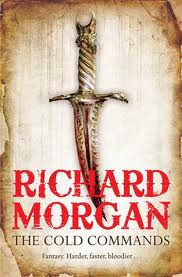
The Cold Commands

I’ve been looking forward to this one for a while. It turns out that The Steel Remains was the first in a trilogy after all. Richard Morgan’s The Cold Commands is the second in the series.

Ringil is busy exacting revenge on the slave traders who took his cousin. He slaughters a whole caravan and heads into the nearest city to hide out from those looking to hold him accountable. While there he has a number of experiences which seem to add up to the divine taking an interest in his activities and finds himself on a boat headed for Yelteth. Which happens to be where Archeth is, back at the court of the increasingly paranoid and violent Jhiral II, and planning an expedition to find a lost Kiriath city. Egar is also in Yelteth, ostensibly guarding Archeth but is bored with this and starts looking for trouble. He finds it and uncovers a dwenda incursion in the heart of the city. When Archeth realises Ringil is in town she signs him up for her expedition and they rescue Eg from the trouble he’s got himself into.

This was enormously good fun. It is not quite what the first book was and I think that is in part because this is a middle book. It is less grim, less violent and less sexual, although less is very much relative here – there’s still plenty of all those things. There is more about the incursions of alien races into this world and consequently less characterization. I don’t feel that I know any of the three protagonists any better than I did at the end of the first book. In many respects The Cold Commands is not as good as The Steel Remains, but it sets up the third book in an exciting way. I still enjoyed it immensely and am looking forward to the concluding part of the trilogy.