Tiger of Talmare

Tiger of Talmare by Nina Scott is a novella that I stumbled across while I was browsing Amazon for contemporary science fiction written by women.

Mel is a space pirate who has been hired to hijack a spaceship carrying the cryogenically frozen Zach to be tried for a massacre on Talmare. Zach is a tiger-human hybrid soldier, who happens to have been chasing Mel across the galaxy for the last ten years, ever since she stole his ship.

The cryochamber is damaged so Mel has to revive Zach. He convinces her he’s innocent. The man who hired her is the real culprit and is trying to silence Zach. As the story is uncovered it turns out there is connection to a troubled member of Mel’s crew so Mel decides to do the right thing. And as this is a romance as much as an adventure, Mel and Zach get it on.

This is a fun romp heavy on action and dialogue. These elements are well done and the book is pretty entertaining. It’s a novella, coming in at a mere 100 pages, so there’s not much room for anything else. I think these characters have a lot of potential and if the story was fleshed out with description and context it would make a great novel.

I liked it. It’s currently free as an ebook, so give it a go.

On a side note, I’m keen to read science fiction written by women. Any suggestions? I’m looking for people publishing now, rather than classics of the genre.

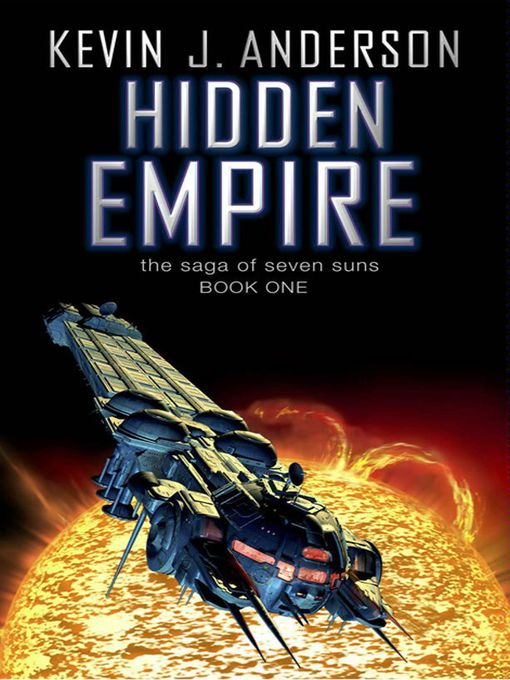
The Hidden Empire

The Hidden Empire by Kevin J. Anderson is the first book in The Saga of Seven Suns series which runs to seven books. It’s a meaty space opera of around 660 pages. A nice substantial book to really get my teeth into. In theory.

Humanity expanded out into the universe in generation ships. They encountered the Ildirans who gave them advanced technology for spaceflight and helped them settle colony planets. They’ve discovered another extinct alien race and in the course of learning about them they’ve found a tool for tunring gas giants into suns.

Using this tool triggers a third alien race to reveal themselves and declare war on both humans and Ildirans.

As this is the first book in a series of seven it is largely setting up the war. Through numerous characters Anderson builds up a picture of human and Ildiran society and draws the relationships between them. The Hidden Empire is broad in scope which I liked, but it lacks depth which I didn’t like.

Chapters are short, lasting only one or two scenes. This makes the pace quite quick. The chapters are told from the point of view of a single character and often ends refering to the character whose chapter is next so there is a pleasing chain effect.

What it lacks is depth. There is one main bit of human society (Hansa) and two further cultures (Theroc and Roamer) which have a tense relationship with the main bit. But the groupings are simplistic. For example, the Hansa have devolved to a psuedo-monarchy for their system of government and the rationale seems rather weak. There is also a lack of understanding of the dynamics of oppression and marginalisation. The characters are shallow stereotypes that exist primarily as narrative mouthpieces. The whole thing is heteronormative and white-centric – probably not consciously, but it does demonstrate a lack of thought or analysis.

I finished it (and I won’t be finishing anything truely terrible this year), but I won’t be reading the rest of the saga. While I do love fiction with a broad sweep I need that to be balanced with depth, good characters and complex relationships.

The problem of simile

Simile: a figure of speech in which two unlike things are explicitly compared, as in “she is like a rose”.

Similes are useful as a descriptive shortcut. They rely on the reader understanding what qualities a rose has that might be applied to a woman. Is it that she is a particular colour? Capable of photosynthesis? Thorny? Possessed of exquisite and delicate beauty?

In fiction there is a further level of assumption, not only that the reader knows what qualities the simile is eliciting, but that the characters have that understanding too. In science fiction and fantasy simile becomes a problem. Do roses exist in your world? If you’re writing fantasy set in an earth-like world there probably are roses and you can use them in simile without trouble. If you’re writing space opera set in a time and place far away from comtemporary earth then you’re going to have to give it a bit more thought.

In something I was reading lately, a space opera, a character visiting an alien world and culture describes an animal as resembling the komodo dragon from old earth. This character doesn’t come from earth. She is a second or third generation (at least) colonist. The planet was colonised by descendants of the original colonists who set out in a generation ship about one hundred years in the future. If komodo dragons still exist on earth what are the chances of this character having the first idea what they look like? The effect is that the reader’s immersion in the world of the novel is disrupted.

So, if I can’t rely on simile for creating a picture in the mind of the readers, what can I do? Well, one solution is to get better at description. It seems to me similes are the lazy option. Taking the time to describe my worlds without using references to things my readers would be familiar with will add greater depth to my stories.

The other option is to create similes that work within the world. This is something that could be derived from effective description. Characters would naturally compare things to other things, but only to things with which they are familiar. The trick is creating that familarity with the reader. This definitely seems like a more challenging solution but one which might lift my writing a bit above the ordinary. If I can pull it off.

The Memoirs of Cleopatra

I love a big book – it’s very satisfying. There is a depth of immersion that just can’t be achieved in anything less than 500 pages. The Memoirs of Cleopatra by Margaret George is a big book at 960 pages and it is well worth the effort.

The memoirs tell the story of the whole life of Cleopatra; from growing up in Alexandria to her death by suicide at the age of forty. It covers her relationship with Caesar, her part in the chaos after his death and the side she eventually chose. That was the side of Marc Anthony and the book details their unsuccessful war with Octavian.

Margaret George derives a lot of the events from the historical record – relying on a broad range of sources and stripping away the exaggerations and defamations of Cleopatra’s enemies. Some things are fictionalised but as much as possible is derived from the historical clues available.

It is an interesting story in that it is essentially the story of defeat all the way through. Cleopatra snatches her country from the machinations of her siblings and aligns herself with Caesar to preserve her throne. Which fateful decision sets her up for a lifetime of trying to prevent Egypt from becoming a Roman province. She fails at that, and ironically, it is a far richer prize at the end than it would have been if she had not saved it in the first place.

This was utterly engaging. The worldbuilding is very good and Rome and Egypt are fully realised. The staggering wealth of Cleopatra is effectively conveyed. I really enjoyed this.

A Diary of The Lady

So, how do you review a book you didn’t finish? There might be a few more of these this year.

A Diary of The Lady by Rachel Johnson is an account of her time as editor of The Lady magazine. She is the sister of Boris Johnson, a columnist for one of the broadsheets, and a novellist. I got about a quarter of the way through before abandoning it.

I stopped reading because I found the writing dull and leaden. It could have been an interesting, funny story, but Rachel Johnson contrives to make it and herself come across as boring and unpleasant. Give it a wide berth.  

I learnt a new word

I love new words. Especially when I’ve been looking for them for a long time. For ages I been trying to think of a way to describe those little phrases and saying that seem harmless but are actually harmful. They’re often said without intent, but tend to provoke defensiveness when challenged.

Lo and behold, someone has coined a word to describe these things: microagressions. And helpfully, there is a blog full of examples.

I’ve started so I’ll finish

Our lives are controlled by the things we believe and we’re not totally aware of everything we believe. Our beliefs can be revealed to us in the little phrases and sayings that we like to use. One of mine is ‘I’ve started so I’ll finish’ and variations on that theme. The belief is that if I’ve started something I should finish it. While that can be a useful piece of advice, because some things are better finished, it can more often be a source of stress. It is not true that everything should be finished. The things that are unfinished because I no longer want to do them become part of a to-do list which can get overwhelming.

Sometimes, the best thing to do is to admit you’re never going to finish something and get rid of it. So, in the spirit of making my life less stressful, I’ve been through book mountain and found thirteen books I’m not going to finish reading.

1. A Time of Exile by Katherine Kerr. I picked it up from the book drop at work as I needed something to read on the way home. I read about fifty pages and I’m not going to read any more. I don’t like the style of writing – it’s too high fantasy for my taste. Back to the book drop.

2. Dark Secret by Christine Feehan. I actually got three-quarters of the way through this, but one day I put it down and didn’t pick it up again. It’s paranormal romance and I don’t like the highly traditional gender roles advocated by the book. Charity bag.

3. Labyrinth by Kare Mosse. This was given to me and I do think it’s the polite thing to do to read something given to you. But I tried and I just didn’t engage with it. Charity bag.

4. The Historian by Elisabeth Kostova. See above.

5. & 6. Magic Study and Fire Study by Maria V. Snyder. These are parts two and three of a trilogy I foolishly bought all together. I read the first one, Poison Study, and I really didn’t like it. I haven’t been able to bring myself to read the other two. Charity bag.

7. A Fine Balance by Rohinton Mistry. I bought this because a friend raved about it. That was before I read Captain Corelli’s Mandolin on his recommendation and realised I hate his taste in books. Charity bag.

8. Winterbirth by Brian Ruckley. I’ve made two attempts at this and I just can’t get into it. To me, it seems like a massive, poorly executed, rip-off of Game of Thrones. Charity bag.

9. Medusa Rising by Cindy Dees. It’s Mills & Boon with a modern military setting. Did. Not. Like. Charity bag.

10. Once by James Herbert. It started off ok but got really slow in the middle. Once I’d stopped reading it I developed an aversion to starting it again. Charity bag.

11. “Dumbth” by Steve Allen. I understand this man is supposed to be funny. I don’t think so. The premise is interesting – 101 ways to think better – and there are some great concepts in here. Unfortunately it’s all conveyed covered in nasty, judgemental, mean-spirited mocking of people perceived by the author as stupid, rude or uneducated. Reading it was a horrible experience. I want to burn it.

12. Wolf of the Plains by Conn Iggulden. Should be the sort of thing I would enjoy, but the writing wasn’t great. It is heavy on exposition and I got bored. Charity bag.

13. Wildwood by Roger Deakin. This one I’m actually a little sad about. I so wanted this to be good, but I’ve given it a couple of tries and I was bored by it. I know someone who wants to read it and hopefully he will enjoy it.

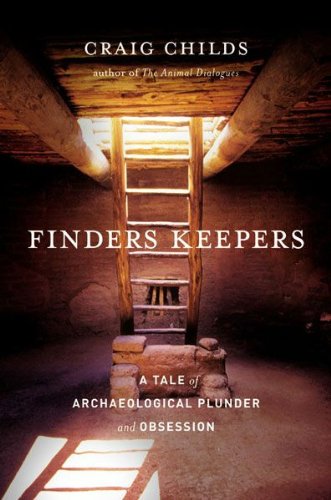
Finders Keepers: A Tale of Archaeological Plunder and Obsession

New for 2012! Book reviews for non-fiction titles! I read quite a bit of non-fiction and, as my reviews have slid away from being purely about what I’ve learned about writing through reading into more traditional book review territory, I thought it was time I started recording those as well. First book of the year is Finders Keepers: A Tale of Archaeological Plunder and Obsession by Craig Childs.

The book is an exploration of the ethics of archaeology and I was attracted to reading it because I have a love for the artifacts of the past. Archaeologist was one of my many answers to the question ‘what do you want to be when you grow up?’. The book isn’t quite what I thought it was. I expected a more scholarly approach to the complex and ambiguous question of what we should do with old stuff.

Who should have it? Does it belong in museums where it can be studied? Lots of the stuff in museums has been obtained unethically, especially in the top institutions. Should it go back to the culture it came from? Are artifacts art or information? Should they be displayed for aesthetic enjoyment or catalogued for posterity? Should they be owned by private collectors or held by governments and public insitutions?

There are no easy answers to these questions and Childs presents a range of views in an objective and non-judgemental way. He tells his own stories of his experience of making archaeological finds and what he has done with them, as well as the stories of people involved at various levels of the antiquities trade.

In the end, Childs’ view is that artifacts should be left where they are found, in context. But this view is based on feeling and he struggles to articulate why that is the right thing to do, so the reader is left to make up their own mind if they can.

I enjoyed this, even though it wasn’t quite what I thought it would be, and if you’re interested in old stuff, museums or archaeology it’s worth a read.

Kindles and page fondling

I got a Kindle for Christmas. Yay me. Not exactly newsworthy on its own, but I noticed something interesting the other day. When I’m reading a book I get a tactile experience that reminded me of the habit forming behaviours that go along with smoking. With the Kindle, my hands are fidgety.

I’m not a luddite in any sense. I love technology and usually can’t wait to get my hands on new kit. I’ve only delayed getting a Kindle this long because of the sheer number of unread books in my house. I thought that having a Kindle would mean I wouldn’t read any of them and I promised myself I could have it when I’d read all the unread books. What actually happened was that I kept buying books so the unread books pile is not that much smaller. I decided I would ask for a Kindle for Christmas, continue to read the unread books and only buy new ones for the Kindle.

Over the last few days I’ve had a bit of a cold so I grabbed a couple of books and headed for a snuggly blanket-laden sofa. I finished Others in hard copy then picked up my Kindle on which I am reading the first book club book of 2012 (it’s awful, but more on that at the end of the month) and read that for a bit. Then I started on Finders Keepers in hard copy.

I had noticed with the Kindle that if I’m not careful I press the forward page buttons on the side and lose my place, so I have some difficulty finding a comfortable holding position. It doesn’t yet feel quite right in my hands. When I picked up an actual book to read I found myself fondling the pages. There’s something about the feel of the paper books are printed on – this particular book was using a soft but thick paper that was especially pleasing to the touch.

Part of the difficulty in overcoming addictions like smoking is the way our bodies get used to certain actions and sensations. So, it is not just the addiction to nicotine, but also the addiction to having something in our hands, to the feeling and motions, to the habit of the actions associated with smoking a cigarette. When you give up smoking, as I did five or six years ago, you have to give your hands something else to do.

It made me wonder if some people who are clinging to the printed book as the ultimate media for delivering fiction dislike e-book readers because they don’t feel right in your hands. They feel different, and therefore, a bit strange. A little disconcerting, even. I wonder if the nay-sayers have an addiction to the physicality of books rather than to the content of books.

Maybe I’ll just get a cover for my Kindle that is pleasing to the touch and that will solve the problem. Maybe that’s why most seem to be in suede.