Archives

100 Books in 2011: The Left Hand of God

The Left Hand of God by Paul Hoffman is the first of a trilogy following the life of Thomas Cale, a strange boy with a dent in his head and the uncanny ability to anticipate an opponent’s moves.

We meet Cale in the Sanctuary, a sort of monastery/training school for boys who are to become Redeemers. The faith expressed by Redeemers is a thinly veiled version of the Abrahamic religions and the Sanctuary is a brutal environment where the boys are treated with such violence and neglect that many of them don’t survive. Cale is a survivor and what that makes of him is delicately handled, for the most part.

Cale discovers one of the Redeemers dissecting a girl while another girl is tied up waiting for it to be her turn. He kills the Redeemer and then has to escape. He takes with him two associates (friendship is an offence punishable by being beaten to death) because he believes they will suffer once he is discovered missing.

Against the odds, they evade the Redeemers sent to capture them and end up in Memphis, capital city of a nearby Empire. There they discover a world ruled by subtle gradations of status conferred by birth and bloodline. The Chancellor is a talented and intelligent man and recognises that Cale can give them information about the Sanctuary. He sends them to the Empire’s military training academy where they wreak havoc and make some enemies. In passing, Cale meets the daughter of the Marshal of the Empire and falls in love. Said daughter, Arbell Swan-Neck, is kidnapped by the Redeemers in an attempt to draw the Empire into battle. Cale rescues her. The Redeemers attack again and Cale is forced to admit that the tactics they are using are his, but that he doesn’t know what the big picture is. He doesn’t know why the Redeemers are attacking, or really why they do anything. In the end, Cale finds himself back in the possession of the Redeemers.

This is an odd book. It starts off well. The initial chapters introducing us to the Sanctuary and the relationship between the boys are great. They are delightfully disturbing and the environment is solidly evoked. This world seems very real. The writing style is compelling and engaging. Characterisation is good, although less so for the female characters. The action and dialogue are great, keeping the book moving at a nice pace. This first quarter of the book is definitely the best and it is worth reading just for this.

Then it all gets a bit wobbly. The quality of the writing remains high and the style is still compelling. In fact, the writing style is basically what carried me through the rest of the book because there are some weaknesses. The main weakness is the worldbuilding. When the setting is the Sanctuary it’s really good. This is a real place with great detail and an oppressive sense of horror about it. Outside the Sanctuary, everything seems a bit haphazard. Nothing seems to fit together particularly and there is some confusion about where places are in relation to each other.

If the POV was tight third person centred on Cale you could argue that he wouldn’t have the first idea about the world outside the Sanctuary and that it would all be confused. But Hoffman uses a loose third person POV for various characters and frequently slips into an omniscient POV where the authorial voice can be used. His handling of POV is good and the changes flow smoothly. The use of the authorial voice contributes to the engaging nature of the writing style. However it jars badly with the poor worldbuilding. There are POV characters who would know exactly how their world works but they are never used to convey that information to the reader. And there’s no map so you can’t check (although I believe that if worldbuilding is done well a map is unnecessary).

To compound the rather haphazard communication of the worldbuilding, Hoffman randomly throws in elements of the real world, which, to my mind, only adds to the confusion. It starts with a reference to the Norwegians (never followed up), then one to the Middle East, then the Redeemers attack a city called York. I’m wondering if this is more of an alternative history than a fantasy but this is never revealed. (Whilst looking for the image for this post I went on the Left Hand of God website which has a map. It’s not this world.) Towards the end, in a discussion about the cost of war, there is mention of a group of people called Jews who happen to live in a ghetto and lend money.

I know most fantasy worlds are based on elements of the real world and that some authors are better at it than others, but this is just lazy. It feels like he was just making it up as he was going along with absolutely no regard for internal coherence. It’s annoying. But other elements of the book are really good. I don’t really know whether to recommend it or not. I enjoyed it but also was frustrated with it.
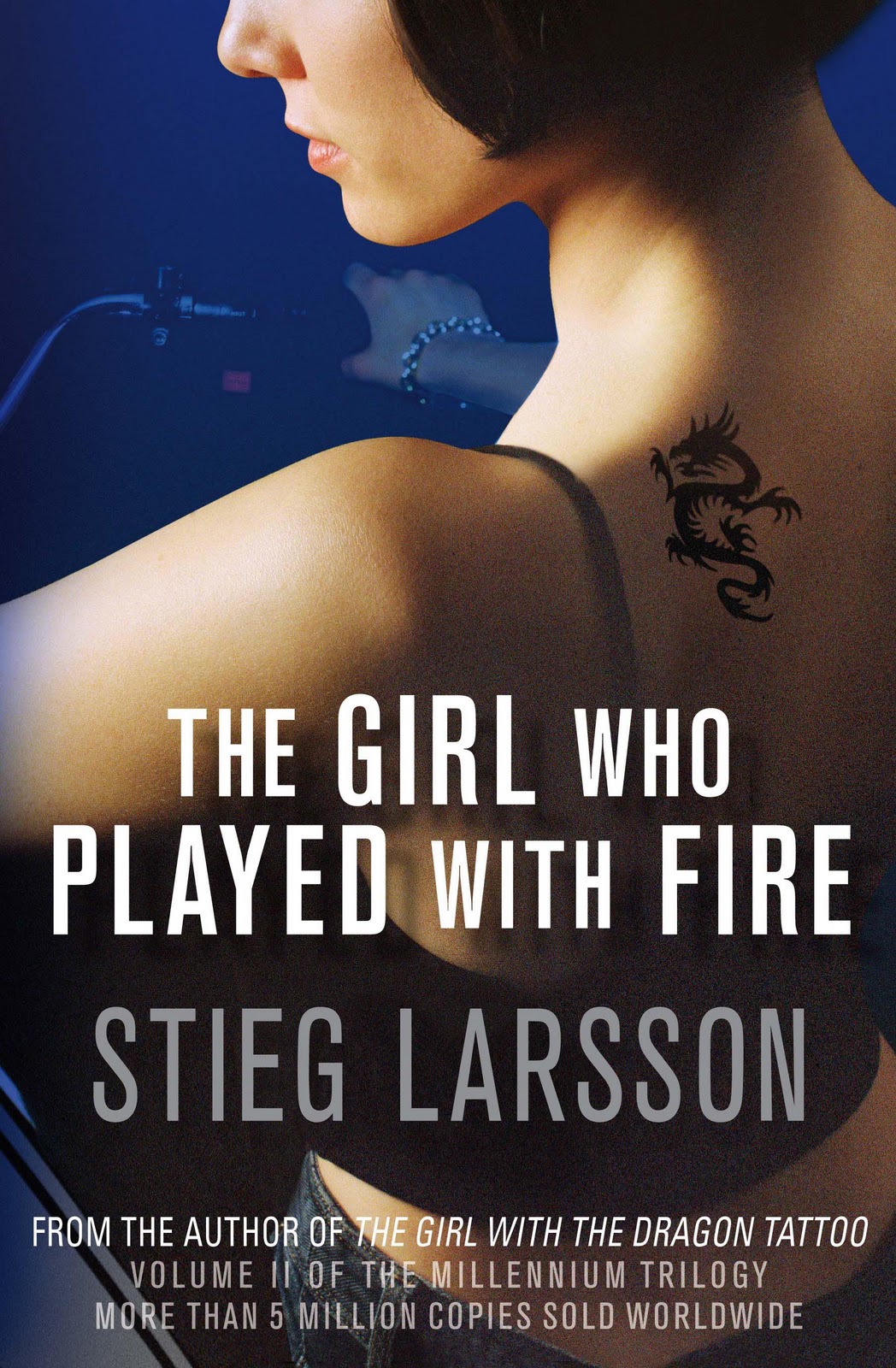
100 Books in 2011: The Girl who Played with Fire

I’ve become fed up of reading short books in order to hit my 100 books for the year target and was feeling the need to get into something more substantial. The Girl who Played with Fire by Steig Larsson is the second in the Millenium trilogy and is a 650 page brick.

Lisbeth Salander is hiding out in the Carribean, having had some cosmetic surgery and done a bit of travelling. She’s wondering what she will do with herself now she doesn’t have to work for a living.

Blomkvist is working on an expose of the sex trade in Sweden. Salander comes back and starts to pick up the pieces of her life, including checking in on her guardian and making sure that she is on track to be declared competent. But her guardian has hired a hitman to kill her. Then the journalists Blomkvist is working with get killed and it looks like Salander is the murderer.

The police investigation focusses on finding Salander but Blomkvist doesn’t believe she did it and does his own investigation. Salander takes matters into her own hands. All three investigations come together in a tense climax with some interesting revelations, which hopefully will be expanded on in the last book.

This book was actually a little better than the first one. It still suffered from a lack of editing, especially visible in the frequent summing up passages. It probably could have been a hundred pages shorter without losing anything.

The dialogue is stiff and stilted but the pacing of the action sequences is good. The plot and story line are really exciting and the characters are becoming more rounded and engaging. I wouldn’t make this top of your reading list, but it is worth reading.

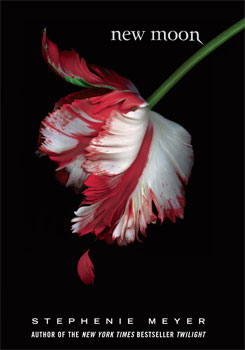
100 Books in 2011: New Moon

The second book of the Twilight Saga by Stephanie Meyer is New Moon. In this part Edward leaves Bella, for her own good natch, and she goes into a big funk for months. Then she discovers that if she engages in activities that could kill her, her subconscious provides an hallucination of Edward being all domineering. She hangs out with Jacob who falls in love with her and turns out to be a werewolf. Bella wonders if she can settle for being adored by someone she can’t love but then discovers Edward has gone off to get himself killed because he can’t live without her.

Bella goes off to find Edward in the company of Alice (Edward’s sort of vampire sister), meets lots of scary vampires who like to eat people, and brings Edward back. She bangs on a lot about wanting to be a vampire.

There’s even less plot in New Moon than there was in Twilight and even more disturbing relationships. The quality of the writing has slipped a bit from the first book and doesn’t seem quite as polished. It wasn’t as engaging and afterwards I felt a bit dirty.

Now I really understand what the issue is with these books. Twilight was ok, really it wasn’t any worse than your average romance novel. But New Moon takes it to another level. Bella only regains any happiness when imaginary Edward is abusively yelling at her in her hallucinations.

Then there is a really telling moment at the end. Edward has been his usual terse, controlling self who appears to only speak to Bella in order to correct her, admonish her or berate her over something. He acts as though he hates her. But for a moment, at the end, after he has left her and tried to kill herself, he makes a speech about how he loves her to distraction really, and all his arsehattery is because he loves her so much. It was a little out of place and read like the sort of thing the author wishes someone would say to her.

It is tragic that this resonates with so many women and girls.

100 Books in 2011: Sword Song

Book 4 in Bernard Cornwell’s Saxon Stories is Sword Song. Cornwell is one of my favourite authors and I am really enjoying the Saxon Stories.

Uhtred is nowhere nearer Bebbanburg. He’s busy building forts to protect Wessex from the Danes and raising a family. Then some Danes invade London, try to convince Uhtred to join them by promising to make him King of Mercia so that he will bring Ragnar to join the cause.

At the same time, Uhtred’s cousin Aethelred, is married to Alfred’s daughter, Aethelflaed and becomes the Lord of Mercia. Not king though; Alfred doesn’t want a King in Mercia. Alfred commands Uhtred to drive the Danes from London. He gives Aethelred the nominal command of the mission.

They win the battle for London and the Danes take refuge in the Kingdom of East Anglia from where they raid Wessex. On one of these raids, Aethelflaed is taken hostage and an enormous ransom is demanded. If it is paid, the Danes will have enough money to raise an army capable of overrunning Wessex. Uhtred is sent to negotiate and discovers that Aethelflaed has fallen in love with one of the Danes and they want to run away together. Uhtred is fond of Alfred’s daughter and knows that her husband is violent and jealous, and if she goes with her lover then the ransom won’t have to be paid and Wessex will be safe. So he agrees to help them escape.

I think I was grinning from the minute I opened this book. I like the character of Uhtred. It’s told in first person but from the point of view of the elderly Uhtred looking back on his life, so the character can be presented as arrogant and impulsive, but with the self-deprecating awareness of experience. It’s extremely likeable. Uhtred is a torn man. He’s bound by oaths he doesn’t want to keep and which prevent him following his dream. I can certainly identify with that.

A good third of the book is taken up by a detailed description of the battle for London, which is very exciting, but the consequence is that the plot feels quite thin in this book. I don’t remember thinking that for the previous three. However, it is gripping and the Saxon Britain is fully brought to life. As always, Cornwell’s skill is evident and the writing is excellent. I thoroughly enjoyed it and am looking forward to book five.

100 Books in 2011: Pig Island

I’m getting pretty good at judging whether what I’ve got left of a book will last me to the end of my commute. Unless, of course, the train dies at an obscure little station that I normally never see because my train goes through it so quickly. Which is what happened a couple of weeks ago and my commute in the morning took me an hour longer than usual. Thus I needed a new book for the journey home and I went to the book drop at work (which is a brilliant thing to have) to find something to read.

As I’m now racing to catch up on the 100 Books in 2011 Challenge, I was looking for an easy read. Pig Island by Mo Hayder is certainly that. It’s a good five hundred pages but was quick to get through. Joe Oakes is a journalist who specialises in uncovering hoaxes of a spiritual or supernatural kind, after having been taken in by Malachi Dove when he was a young man. His girlfriend, Lexie, comes with him, thinking it is some sort of holiday.

Joe is investigating a video of a devil seen wandering around Pig Island, which is the home of a reclusive cult led by Malachi. When he gets to the island he finds Malachi has left the cult, lives on the other side of the island and keeps his privacy by means of an electric fence.

All the cultists are locked in their church and burnt and it seems like the work of Malachi. Joe goes to investigate and discovers that Malachi had a daughter. This daughter,Angeline, has a tail and appears to be frightened and fragile. Joe takes her back with him. Lexie, until recently a receptionist for a Harley Street plastic surgeon, recognises that what Angeline has is the remnants of a conjoined twin and thinks this will get her back in with her former employee.

Course, not that simple and Angeline turns out to be what everyone thought she was.

It was ok. Neither the characters, Joe or Lexie, are particularly sympathetic. Lexie, especially, is quite unpleasant. Joe seems ok until the point of view switches to Lexie and he doesn’t treat her very well. It wasn’t scary but it was nicely creepy in places with one or two genuinely shocking moments. The plot was handled ok but I could see the big reveal at the end coming from just after the halfway point. If you’re looking for brain candyfloss, this would be just the thing.

100 Books in 2011: Winter Song

Winter Song by Colin Harvey is the third book I’ve read from small press Angry Robot. As I’ve thoroughly enjoyed all of them and have paid for none of them (they’ve all been freebies from conferences or joining the British Fantasy Society), I’m feeling a bit uneasy. I think I might have to make a point of buying some more books from them.
Karl Allman’s spaceship is attacked and he bails out, landing on a barely habitable planet. Centuries ago, humans spread out from Earth. In some cases, people were genetically altered to be able to cope with conditions on planets not habitable by ordinary humans. In other cases, planets were terraformed. Since then, the factions have split and humanity is at war with itself. Allman’s ship gets caught in the crossfire and the planet he lands on is one where terraforming was started but not properly finished.
He is found by a community of people who colonised this ice planet so they could live a traditional Icelandic life. In this community, there is a girl named Bera, grieving her dead baby, who is scorned and rejected by the rest of the community because she won’t name the father of the baby. She nurses Allman back to health at which point, the head of the community, Ragnar, demands that he work to pay off his debt. He learns that the world is basically poisonous to humans, the terraforming is reversing, and there are other creatures, trolls, that might be sentient.
Allman learns from Bera that the remains of the original colonists’ ship, the Winter Song, lie somewhere far to the south. Ragnar won’t let him leave so he has to escape and Bera comes with him. They journey across the ice, followed by Ragnar, and along the way, Allman learns that Bera was raped. They also encounter a troll and discover that the trolls are modified humans that settled the planet before it was terraformed. 
I loved this. The story is complex and deals with a number of themes, which are handled so well that it is never overwhelming. Harvey writes POVs from both Allman and Bera and conveys the miscommunication in their relationship brilliantly and with sensitivity. This is an example of really good science fiction. It’s a human story that’s prime focus is the characters, set in a hard sci-fi world that highlights some serious social themes. The resolution of the story is excellent; it’s downbeat but perfect for the story and emotionally satisfying.
And there are sort of Vikings. Is it just me? Am I just picking books that take inspiration from Norse mythology and the Vikings? Or there a Viking theme in publishing right now? 
Anyway, this was really good. I recommend it.

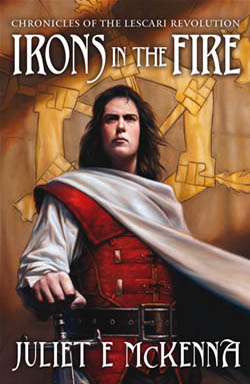
100 Books in 2011: Irons in the Fire

I picked up Irons in the Fire by Juliet E. McKenna at Alt.com a couple of years ago. Juliet McKenna does quite a few writing conferences and I’d heard a lot of what she has to say about writing and the writing life. I thought I ought to read one of her books.
McKenna is published by Solaris Books and I guess I wondered what differentiated authors who are with small presses from those with the big publishers. In between buying this book and reading it I’ve read three Angry Robot books, all of which were excellent, so I’m not sure there are any conclusions to be drawn.
Irons in the Fire is the first in a trilogy. It is set in a fantasy world where the Kingdom of Lescar is being torn apart by incessant civil war. Many people have left or sent their children away, so there are substantial communities of Lescari in other countries. Tathrin is the son of an innkeeper sent to study in the city of Vanam in the country of Ensaimin. There he meets Aremil, the crippled son of one of the Lescari Dukes and find himself drawn into a conspiracy to bring peace to Lescar. Along the way, a small band of conspirators is drawn together, all with different agendas and Tathrin finds that he’s not entirely comfortable with some of the actions they take.
I think the problem I had with this book is that the characters were too ordinary. I didn’t enjoy it very much and found it hard to stick with. The writing is ok – it starts off a bit ropey but settles down quite quickly. It’s not great but it’s better than some books put out by bigger publishers. It was quite an easy read and the pacing was good. It’s seven hundred pages and, in terms of the time I spent actually reading it, didn’t take that long to finish. But I did put it down and read two other books before I made myself complete this.
So, I asked myself, what is it that’s missing? Why isn’t this engaging me? There’s two things; the characters and the world. I didn’t buy into McKenna’s worldbuilding. Perhaps it’s because I haven’t read any of her other books, which I believe are set in the same world, that I found that there were a lot of things left undeveloped. It just didn’t feel that solid. For example, there were gods, which I knew because people swore by them and there were shrines. But there was no information about how the gods related to each other, or to society, or about what impact religion has upon the world. It felt superficial.
Maybe that wouldn’t have mattered if I’d really liked the characters. It was difficult to feel anything about them at all because they were flat and ordinary and not well-drawn. The POV characters lacked passion and depth. There was much telling about how they felt that was not backed up in dialogue or action. The other main characters who didn’t have POVs were potentially interesting but just didn’t jump off the page. They were not characters who I would think about whilst not reading the book. Also, I think the guy on the cover is supposed to be Tathrin, but I think it says quite a lot that I’m really not sure. I can’t connect the picture on the front with the character in the book.
I won’t read anything else by Juliet McKenna and if you’re looking for epic fantasy, there’s much better stuff available. But I will give Solaris Books another go if I find something that looks interesting.

100 Books in 2011: All the Windwracked Stars

All the Windwracked Stars by Elizabeth Bear is a bit genre-busting. It is heavily grounded in Norse mythology with liberal sprinklings of sci-fi, steampunk and high fantasy.
After Ragnarok, of which there are and will be many, one Valkyrie survives because she ran away. Her name is Muire. When she comes back after the battle, wracked with shame, she finds a single valraven still alive who takes her for his rider. She heals him and, in doing so, turns him from a flesh and blood creature to one of metal and fire. Then she rejects him. Centuries later, Muire is living in the sole remaining city of Valdyrgard which is kept alive through technomancy while the rest of the world dies around it.
Mingan, the Grey Wolf (Fenrir?), returns to Valdyrgard, hunting for something. Muire senses him and believes she must kill him to avoid another Ragnarok. In tracking him down, she discovers that the souls of the Valkyrie have been reborn as new people. These new people don’t remember themselves but Muire and Mingan know who they are. An ancient love-triangle is reignited. Muire wants to restore the Valkyrie to themselves.
I loved this. It is dark and sexy, full of flawed characters trying to do the right thing, but finding it hard to work out what that is. The characters are complex and complicated and so are the relationships between them. The villains have excellent motives and it is hard not to sympathise. The heroes want to do what’s right, but the consequences of that are often wrong. They all struggle with the way they feel and the burdens they carry.
The language is lyrical and poetic. The rhythm is slightly odd but perfectly pitched. I really enjoyed reading it for the sake of the arrangement of the words. It was lovely.
If I have a criticism, it’s that it is a shame that the only person of colour in the book is the most abused, damaged, infantilised and sexualised character in the book. Those two things didn’t have to belong to the same person and it plays into some unpleasant racial tropes.
Other than that, this was one of the most engaging books I’ve read this year. I enjoyed it enormously and will definitely pick up more of Elizabeth Bear’s work. Highly recommended!

100 Books in 2011 challenge: Bride of the Solway

More short books! Bride of the Solway by Joanna Maitland is a Mills & Boon (and yes, I still have more of them on book mountain).
Our heroine, Cassie, is the prisoner of her step-brother, the Laird of Langrigg. He has gambling debts and plans to marry his sister to a wealthy but weak husband, just as soon as he can find a suitable mark. Cassie tries to escape and runs into Captain Ross Graham, a man searching for a family. The step-brother captures Cassie, beats up Ross and throws him in gaol.
On getting out of gaol, Ross renews his acquaintance with Colonel Anstruther, whose wife is very sick and is expected to die soon. Cassie’s brother decides that Anstruther will need a new wife soon and that should be Cassie. During visits engineered to endear Cassie to Anstruther, she confides in Ross and they plan an escape to her godfather in England. Once there, Ross discovers that his family are distantly related to Cassie’s godfather. Her brother chased them in their escape and they believe that he died. But he didn’t and snatches Cassie from her godfather’s garden and takes her back to Scotland, where he forces her to marry an old man who paid £5,000 for her.
But Ross comes for her and rescues her at the altar. They are then married and live happily ever after.
This one annoyed me a lot less than the other Mills & Boon have, largely because there was a lot more plot and a not very much mooning about by either protagonist. Having said that, the plot was still pretty thin and really lacked tension. Without the artifical tension created by the mooning about, i.e. the protagonists’ internal monologue about how they love the other but mustn’t, love the other but also hate the other, love the other but don’t want to admit it, love the other but think the other hates them, etc – the tension must derive from the plot. Will Cassie end up in Bedlam or married off for money? Well, no, the possibility is never believable. I suppose if it was, it couldn’t be a Mills & Boon story. I wonder whether my expectations of this genre are so unshakeably set that there is nothing the author could do to make me doubt what the ending will be. The only way would be to tell a different story. And then Mills and Boon wouldn’t have published it.
The other elements were quite thin as well. Characterisation relied on tropes and the dialogue was actually quite bad, especially when it was in dialect. The one exception was the character of Colonel Anstruther, an old man clearly in love with his dying wife – it was sweetly and poignantly drawn.

100 Books in 2011 challenge: Voodoo River

I’m way behind on the 100 books in 2011 challenge, so I’m picking short, easy reads to try to catch up. Robert Crais is an easy read, and Voodoo River comes in at less than 300 pages.

Elvis Cole is hired to find out about the birth parents of an adopted woman, who is a TV star born in Louisiana. He finds out that her father was black and that her mother’s father killed him, facts known to a local private detective and a local crime lord. The mother and her husband know about the murder and that it was covered up. They’re being blackmailed and the husband, the sheriff, turns a blind eye to the crime lord’s human trafficking business.

It’s a pretty complicated plot to be wrapped up in a short book. It never feels like anything is being revealed too quickly, whilst at the same time, everything is there to make it all add up. It is well done and this is probably the best of Crais’ that I’ve read.

Characterisation is handled well and most characters are reasonably fleshed out. The dialogue got on my nerves a little. Cajun dialect was indicated by dropped letters and phonetic spellings rather than by cadence and word choice. It often felt heavy-handed. Other than that I enjoyed it.