Archives

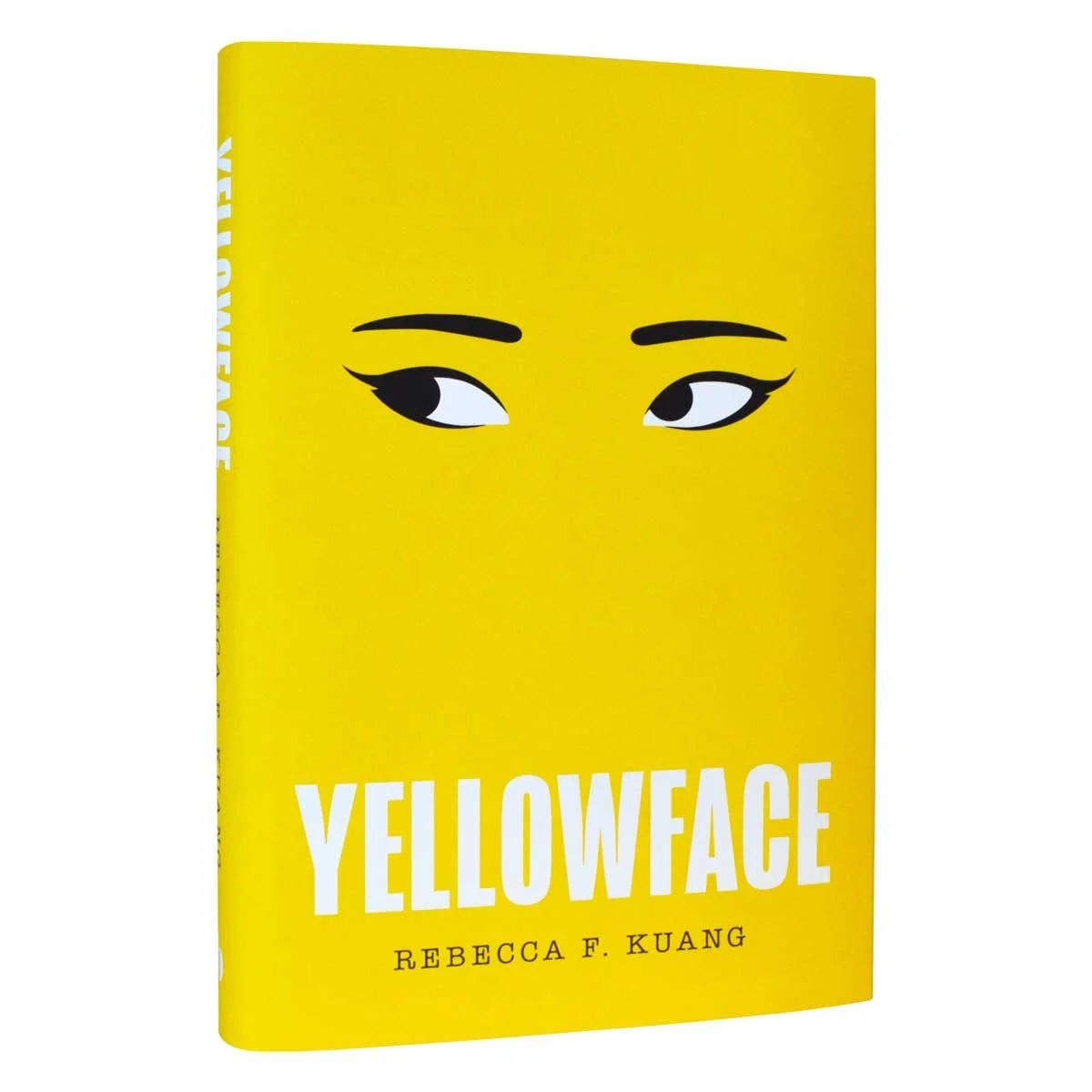
Yellowface

This book has been everywhere lately and I’ve seen lots of good reviews but it’s contemporary literary fiction which is not usually my kind of thing so I didn’t pick it up. When a friend recommended it and offered to lend it to me, I decided I would. Never turn down a free book!

Yellowface by Rebecca F. Kuang is the story of how a white author, June, steals a manuscript from her very successful Asian-American author friend Athena – on the night the friend dies. She takes a first draft of Athena’s next book and develops it and then it gets picked up by her publishers. It’s a success, much more so than her previous books. The publishers editing team supports her with the rewrites. I quite enjoyed the portrayal of how the edits suggested by the editor made the text more problematic – nuance and complexity being removed, foregrounding of white saviour characters – and how June is oblivious to the impact on the story. She’s more concerned with not being found out and being a ‘good’ author.

I also enjoyed the portrayal of the internet storm in a tea cup that develops around claims that June is claiming to be Asian when she’s not, through an ambiguous name change and author photo, and has plagiarized someone else’s work. It fizzles out and doesn’t matter much in the end, by June is thrown into depths of paranoia and guilt. But clueless and unself-aware as she is, June plows on and does it again. Under pressure to produce another book, June rifles through Athena’s notebooks and picks a short paragraph to flesh out into a novel. Unluckily for her, Athena developed this paragraph in writing workshop and the tutor remembers. June is also being haunted online by someone using Athena’s social media account, which adds a pleasing touch of mystery.

I liked it a lot. Enough to buy another of Rebecca Kuang’s books. It is perhaps not as deep and rigorous a critique of the publishing industry as it could be, and is not that literary after all (probably why I liked it), and belongs in that ‘trashy’ novel phase I’m having. It was a fun, easy read which was well-written and thought-provoking in places.

There is an interesting review of the book by @withCindy which I watched. It pulls out the complete lack of analysis around wealth and privilege that impacts success for all people that could have made this book more hard-hitting. I think the review is really on-point and worth watching. Yellowface is still a fun read.

Infomocracy

Periodically, I make an effort to diversify my fiction reading. It’s easy to slip into just reading authors I know, especially those that are quite prolific. My fiction reading has been dominated by John Le Carré, Mick Herron and Adrian Tchaikovsky lately, and it felt like time to find some new authors.

Malka Older was a good choice. I haven’t blogged in a while because I’m studying and that takes up a lot of time but Infomocracy was so good I wanted to share.

Infomocracy is near-future science fiction, set some decades into a future earth. Exactly when isn’t specified but ‘now’ is within living memory. The premise is that government is at a level closer to the citizens. The world is divided into centenals which are geographical groups of 100,000 people. That’s about a third bigger than a parliamentary constituency in the UK. Neighbouring centenals might have very different governments. This is all powered by Information, a global network that provides real-time data on everything with impartial analysis; the theory being that democracy is only possible with an informed populace.

Elections are held every ten years to allow for governing in between campaigning and Infomocracy is set at the third of these elections. The novel follows an Information operative and a campaigner for one of the governing parties, who both find evidence that one or more of the dominant parties (i.e. those with the most centenals around the world) are trying to subvert the system.

This is Older’s first novel and it is really good. Infomocracy is book 1 of a trilogy and I’m looking forward to reading the rest. The characters are engaging, the worldbuilding is solid and the premise is really interesting. I’ll admit, I’m kind of into policy and government and how all these things work so I appreciated the depth of understanding of psephology and how voters engage (or don’t) with facts vs campaigning. It’s also a cracking plot and a lot of fun. If you’re looking for something new to read, this is highly recommended.

The Long Way to a Small Angry Planet

The Long Way to a Small Angry Planet by Becky Chambers is about a crew of space tunnellers who are offered the biggest job they’ve ever had: to travel to the edge of civilized space to a small, uninhabited planet that is pretty much entirely made up of the fuel used to power spacecraft and tunnel their way back. The trip to the planet takes about a year and creating the tunnel will reduce that trip to a day.

This is very much a character driven novel and the bulk of it is spent on the year travelling to the small angry planet and using that as a vehicle to explore ideas about relationships. Those relationships are personal, cultural and societal. The crew is multi-species and the relationships are multi-dimensional; interspecies, same-sex, human-AI, friendship, sexual and romantic. There are a lot of ideas in the book about gender, sexuality, sentience and love. Mostly they are handled well, creatively and vividly realised, and it is refreshing to read sci-fi that is actually addressing the possibilities of connection rather than just treating contemporary norms around relationships as though they are biologically determined (and therefore unchangeable) rather than cultural.

On the larger scale, there are ideas about how people fit into societies and the tension between collectivism and individualism. This is in the background and provides context for the personal relationships. There are themes about conflicts between and within cultural groups and when the crew reach the small angry plant, we see big politics at play that reflect colonial histories and current world dynamics. Some of this is less well handled than the personal relationships.

The Long Way to a Small Angry Planet was a little slow for my tastes. There’s a bit of action at the end when the crew are attacked when they start to tunnel but most of the book is about people relating to each other. It’s worth a read for the ideas explored in it and those who prefer more character-driven fiction may well enjoy it more than I did.

The Goblin Emperor

I picked up The Goblin Emperor by Katherine Addison after EasterCon 2019. I attended a session called Build your Utopia looking for a discussion about creating worlds where humanity’s best traits are foregrounded. I’m kind of sick of the narrative that people are awful and there’s no way to change that. The Goblin Emperor was given as an example of hopepunk, a genre recently emergent as a reaction to grimdark fantasy.

It’s not as if nobody behaves badly in The Goblin Emperor. Maia, the half-goblin fourth son of the Emperor of the Elf kingdom expects only to live out his life in isolated exile. Then his father and three elder brothers are assassinated and his world is turned upside down. Not everyone is thrilled about his ascension to the throne and he faces treachery and an assassination attempt on his own life as well as courtiers seeking to take advantage of his naivety. Maia has to adapt to a complex society that nothing in his life has prepared him for and learn who he can trust. Eventually, he finds his way to identify and remove most of his enemies, to decide what kind of ruler he wants to be (a good one, obvs), and set himself on a hopeful path. Some of the characters are venal, violent and prejudiced. Others are generous, progressive and trustworthy.

Part of the discussion in the session at EasterCon was whether the idea that conflict is story is in itself a form of cultural hegemony. That there are other story traditions that are devalued and ignored because they don’t follow the structure we’re most familiar with. It’s an interesting debate. The hero’s journey structure that so much storytelling in books, tv and film is based on makes it hard to explore some kinds of ideas and concepts.

I enjoyed The Goblin Emperor overall but I found it a bit slow. Also, I never really believed Maia was in peril. There was no point in the book where I doubted that Maia would succeed. I enjoy those moments in a book where you suddenly think it’s not all going to work out okay for your favourite characters. I’m not sure The Goblin Emperor has given me a taste for hopepunk. I love grimdark and, more broadly, I am a sucker for tragedy, but perhaps I should stretch myself and get out of my reading comfort zone.

Redemption’s Blade and Salvation’s Fire

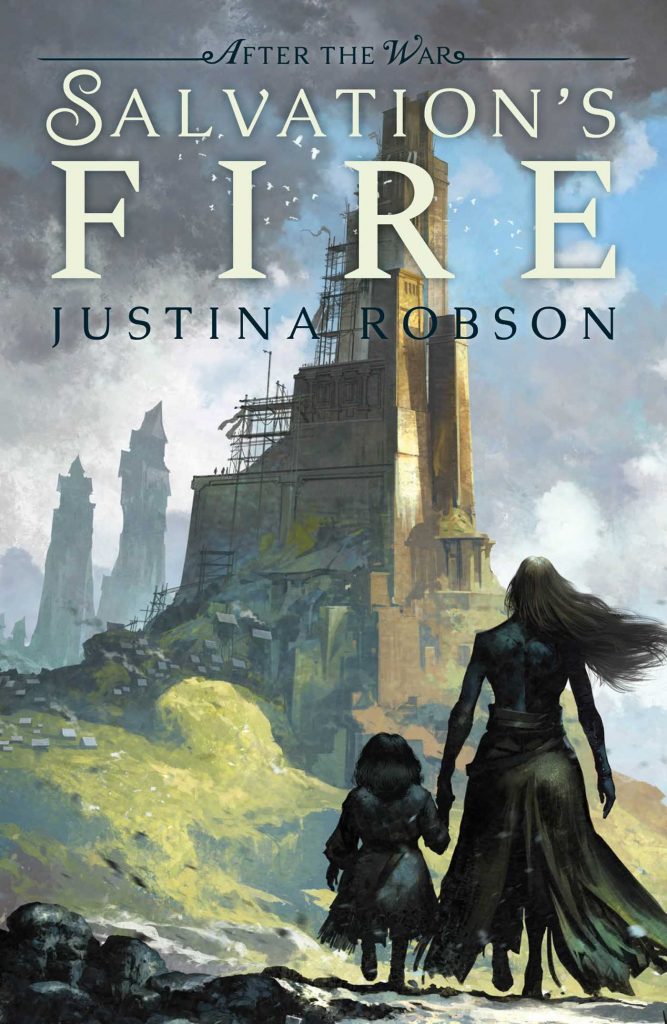
Redemption’s Blade by Adrian Tchaikovsky and Salvation’s Fire by Justina Robson is a duology written by two different authors. It works way better than you might think.
Redemption’s Blade is about what people do in the aftermath of war. Particularly, it’s about what heroes do when the world no longer needs them. The main character is Celestaine the Slayer, who killed the evil demigod trying to destroy the world, but feels guilty about how far he got before she stopped him. I especially enjoyed the treatment of her magic sword which has a blade that can cut through anything and that’s actually really inconvenient. Scabbards don’t last, she had to learn how to fight completely differently, if she accidentally grazes someone they lose a limb. A sword that can carve through basalt makes mincemeat of people.

Celestaine believes if she can find a magical object of sufficient power she can restore one of the peoples who were broken by the evil demigod. Mostly it feels like she won’t, and Celestaine grapples with whether she’s doing it because it’s the right thing to do, or because she thinks it will make her feel better. Complicating things, the evil demigod was one of several demigods who were supposed to protect the world until he went rogue, and the rest of them are acting strangely now. In the end, though, she finds the magical macguffin, kills another demigod to get it, and her magic sword gets broken. Then there’s nothing for it but to go home and face the boredom.

Salvation’s Fire picks up a few weeks later just as Celestaine is finding home life constricting. One of the demigods pitches up to ask her and her companions to come on another quest. The evil demigod severed the world’s connection with the gods and one of the others has an idea about how to restore it. Meanwhile, loose in the world is a magical creature who was made by necromancers to be the bride of the evil demigod, and the person she’s bonded with is small girl whose entire people were slaughtered in the war. When Celestaine finds these two, it somehow seems that they have a role in what is to come, but what that role will be remains unclear. This journey takes them to the far north and then into other dimensions to find the gods, by way of some soul searching and some facing up to what was done in the war.

Adrian Tchaikovsky is quite prolific so there was a lot to choose from when I wanted something to follow the amazing Shadows of the Apt series. Redemption’s Blade is the first I picked up and it doesn’t disappoint. I loved it, couldn’t put it down, and was left wanting more. I was a bit apprehensive about how Salvation’s Fire would match up. Justina Robson’s Living Next Door to the God of Love was incredible and is one of my favourite books. Then I read a couple of her Quantum Gravity series, which are sci-fi/fantasy/spy/cyberpunk mash-ups. They’re good, but not my cup of tea. But there was nothing to worry about. Salvation’s Fire was just as good as Redemption’s Blade. It took the story and made it deeper and more complex. I highly recommend them. I wish there were more.

The Power

You must read this book. This is the best book I’ve read in a very long time.

The Power by Naomi Alderman explores the nature and dynamics of power. Women have evolved the power to deliver excruciating and fatal pain through their hands, and men have not. Using four different characters whose lives eventually intersect, Alderman explores what it means when the tables turn. When I started reading the book, I thought I knew what Alderman was saying with her story. Women start waking up to their power and the women whose stories Alderman tells are all victims of the ones who previously had the power: trafficked women; women in relationships with violent men; girls growing up with fathers that rape them; successful career women undermined by sexist bosses and co-workers. Examples of things that happen to women everyday.

It’s a relatively short book and it is impressive in the number of ways it explores its theme. It contrasts how different political systems react to the emergence of the power and the way men try to fight it – repressive regimes using violence and democratic regimes using manipulation and psychological control. The book looks at religious power and how it is used, and also personal power and what it means.

It was not long before I realised that the point being made is actually much more complex than it appears on the surface, and I realised I didn’t know what the message was. The women in power do unspeakable things to men without power; again, things done by the powerful to the powerless on a daily basis. The point is not that the status quo is fine, because if you just gender-flipped it then everything would essentially be the same. It is that we need to think much more carefully about power and who has it, and what they can do with it. Because most of us do things, even awful things, just because we can. I finished the book thinking that while Alderman had made me think very deeply about power she has done so without taking a didactic position herself. The story always remains paramount.

I enjoyed the gender-flipping of historical objects scattered throughout. I especially loved the epilogue. I won’t spoil it, but I have had that conversation so many frustrating times and I loved what she did with it. I would have liked a bit more exploration of queerness in the book. Alderman touches on girls born without the power and what that means for them, and on boys who have it, and there are illusions to same-sex relationships, and I would have liked to see that more fully developed. On the whole, this is an awesome and important book and I can’t recommend it highly enough.

After Atlas

This book was given to me by the author. This summer I went on an Arvon course on Science Fiction and Fantasy writing led by Emma Newman and Peter Newman. The week is mornings of workshops, afternoons of working on your project, and evenings of readings. On the first evening the tutors read from their own work and then generously gave us each a copy of one of their novels.

After Atlas by Emma Newman is set in an frighteningly plausible future dominated by corporations where advertising is omnipresent and indentured servitude has made a return. Carlos Moreno is a detective, but he is indentured. He has a contract which he has to work off before he can be free. In this story, Carlos is asked to investigate the murder of the leader of a cult called the Circle, from which Carlos escaped when he was 18. It was this escape that led to his capture and slavery. Returning to the Circle to solve the case stirs up a lot of memories, and the cult is not what he thought it was.

The future imagined in this book is an extrapolation of neo-liberal economics and its impact on democracy and any parts of life that are not economic. It is extremely unequal and highly surveilled. Almost nothing a person does goes unnoticed and privacy is reserved for the very rich. I liked the way it was handled and found it believable. I think the question of the balance of convenience and privacy is interesting. The concept of privacy is really a quite modern one. Centuries ago when people lived and worked in the same place all their lives everyone in the village knew everyone else’s business. Living in cities has given us a sense of anonymity that we’ve grown used to and are reluctant to give up.

The other thing I liked about this book is that it is a diverse cast of characters at all levels. A lot of this was done in a quite subtle way and I was a good way through the book before I realised it.

After Atlas is a science-fiction crime thriller, a genre of which I’m fond. It’s fun, and while it touches on some quite serious and weighty topics, it does so with a very light hand. Emma Newman is a good writer and this is an easy and engaging read. I liked it a lot.

Mindplayers

mindplayersMindplayers by Pat Cadigan
Published 1988 by Gollancz

In a world where virtual reality is inside everyone’s head and you can choose to be someone else if you tire of your own personality, somethings are still illegal. Like being crazy without a license. Seeking altered states of consciousness and living an impulsive, directionless life, Allie Haas tries a black market trip into paranoia. It leaves her unconscious and dying and her dealer drops her off at a mental drycleaner, leading to both of them being arrested.

Allie is offered a deal: train as a mindplayer to facilitate the work and games of others, or be imprisoned. She takes the deal.

Mindplayers is a fascinating exploration of our inner mental worlds and how we use narrative to create ourselves and our lives. Allie finds intimacy with others in the mental realm, discovers what happens when someone has their personality stolen and helps other discover meaning in their creative work. It’s like meditation and psychology combined, enhanced and lifted to another level. What might be possible if we could have such insight into ourselves?

I really enjoyed this. It combines great storytelling with serious exploration of science and technology and its impact on humans. Science fiction at its best.

Necrotech

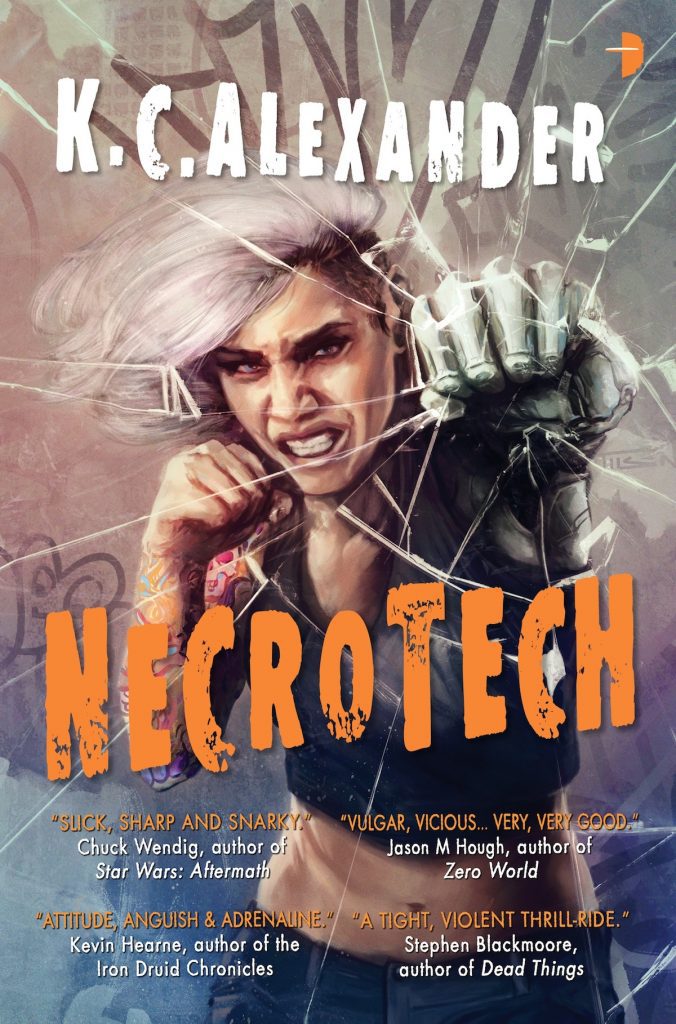
necrotech-book-cover-676x1024Necrotech by K. C. Alexander
Published 2016 by Angry Robot

This was a lot of fun. Riko is a street thug, the muscle in a gang of criminals clinging to existence in a near-future cyberpunk dystopia. She wakes up in an unfamiliar lab and has to fight her way out. Riko thinks it’s just the result of a bender but soon discovers her world is far more messed up than that. In order to find out what happened to her Riko is forced to reassess all her relationships and everything she thinks she knows about her world and herself.

Necrotech is fast-paced and relentless and carried me quickly into the world. It’s possibly the most entertaining book I’ve read this year. The world-building is full of lots of lovely, rich details. I particularly liked the idea that everyone has a chipset implanted in their brain for communications which constantly exposed them to advertising, unless you can pay to remove ads.

Riko is an interesting narrator. She has a bolshy attitude and a strong tendency to punch first and ask questions later – even when she knows full well that this is against her best interests. Towards the end of the book Riko begins to develop some flickers of self-awareness. She has doubts all the way through due to the memory loss – because she doesn’t know what happened she has to question her actions. Some of the evidence she uncovers indicates that she might be involved in activities Riko finds repugnant, and yet she can’t be confident that it’s not true. I hope this is the first in a series because the book ends on the cusp of some serious character development.

If there’s one thing that I found a little disappointing it’s that Riko is a strong female character in a man’s world. In almost all respects, Necrotech has a diverse cast of characters with a range of skin colour, sexuality, and physical abilities presented in a way that adds to the worldbuilding. It’s really very good. Except for the lack of supporting female characters. I would have liked more. But it’s a minor point.

Necrotech is gripping, funny, shocking, and absorbing. I read the first few pages and couldn’t put it down. The pace keeps up all the way through the book and the surprises keep coming as Riko uncovers more. I loved it and I’m looking forward to a sequel.


Four Ways to Forgiveness

forgivenessI love the title of Four Ways to Forgiveness by Ursula Le Guin.

It’s a short story collection and normally I would steer clear of short stories as I don’t find them as satisfying as novels. This book came to me as part of the collection from an emigrating friend and, while I didn’t connect with the Earthsea series, I’d really enjoyed The Left Hand of Darkness. A combination of title and author drew me to the book.

The four stories in Four Ways to Forgiveness are set in the same world/universe as The Left Hand of Darkness on the planets Werel and Yeowe. Werel’s societies are based on enslavement on one ethnic group by another. One nation, Voe Deo, colonised a nearby planet using a largely slave population to exploit the planet’s resources.

The first story, Betrayals, is set on Yeowe after the War of Liberation, in which the slave population overthrew the bosses. Yoss is a retired school teacher who reluctantly cares for her mad neighbour, Abberkam, who was a war lord and now lives alone in a sparsely populated area of Yeowe. Yoss has reasons to hate Abberkam and reasons to distrust men in general, but an attachment forms between them. Then Yoss’s house burns down: Abberkam rescues her cat and offers her a room in his house.

I liked this story the most. It is gentle and wistful, yet approaches some heavy themes. It talks about forms of oppression and how freedom requires more work than simply overthrowing the masters. Age has mellowed two characters who might have been enemies in their younger days, and the relationship is facilitated by Abberkam’s confessions, apologies, and adoption of more respectful behaviour. It is both sweet and real. Forgiveness is reached through time.

Forgiveness Day moves to Werel and the story of an Envoy of the Ekumen in one of the smaller, more traditional, countries. Solly is a female of an egalitarian society and she struggles to adapt to a patriarchal system. Although her struggle isn’t as great as Gatay’s struggle to accept a female Envoy. She strikes up a friendship with a member of a troupe of entertainers – they are transvestites and it is considered shocking to openly associate with them – who also happens to be involved in a movement to liberate Werel’s slaves. The story touches on Solly’s attempts to treat the slaves she’s given as equals and their resistance to her behaviour. There is a terrorist attack and Solly and her bodyguard are taken hostage. During their captivity they come to know each other better and understand the roots of the things they had been offended by. Forgiveness is reached through understanding.

The third story, A Man of the People, is also a story of an outsider to the Werel/Yeowe system. Havzhiva is Hainish and grows up expecting his life to follow a defined pattern. He grows to realise he wants more and leaves his community. It’s a difficult choice as few people leave their community and, if you do, you can never really go back. You might be able to return physically but the psychological connection has changed. Havzhiva spends his youth studying and exploring relationships. Eventually he becomes ambassador to Yeowe and it is there he finds a home. The society is struggling with change. The men believe themselves free but the women find themselves oppressed by the former male slaves. Everyone carries the physical scars of slavery and war. Slaves were allowed no family life or education and those institutions are in their infancy. The cities are changing (progressing) faster than the rural areas. There is conflict between different visions of a free Yeowe. Havzhiva forms a friendship with a nurse that lasts lifetime and at the end he tells her he has learned acceptance. Forgiveness is reached through acceptance.

A Woman’s Liberation, the final story, is the story of Rakam, a female slave. As a child she grows up in a compound and sees her mother rarely. Her mother goes to the house and is not a field slave. As she grows, she knows her skin is darker than the other slaves and comes to realise this is because one of the bosses is her father. Her mother secures her a place in the house as slave to the plantation owner’s wife, Lady Tazeu. She is raped repeatedly by Tazeu, who is isolated and lonely and has limited freedom of her own. Rakam is given to the boss’s son, who refuses to use her because she can’t consent, and tells her that he is working to free all his father’s slaves. When the estate is destroyed and the slaves take their freedom they are simply captured again and taken to another estate. Conditions have become harsher. Rakam says she has papers but they are taken from her. The path to freedom is dangerous and is not one act of liberation but must be defended everyday. Rakam is freed again and makes her way to the city where she educates herself. This story reflects how people internalise the philosophies of oppression as children and must work hard to change what they believe about themselves. Rakam realises that there are layers of freedom struggle. This story is most directly analogous to the institution of slavery on our own world and the complexities of liberation experienced by the enslaved. Rakam becomes a teacher and a writer, a powerful voice and a respected academic. Forgiveness is reached through achievement.

The stories of Four Ways to Forgiveness are all linked and together build up a picture of changing societies and the struggles of the people seeking emancipation. The writing is elegant, the characterisation is deft. These are deeply political stories yet character always comes first. I found them enriching and moving. Not only did I enjoy them as stories, but I learned something about the human experience. Wonderful.