Marked

Marked, by Sl_tingey_markedue Tingey
Published 2015 by Jo Fletcher Books

First read of the books acquired at FantasyCon 2015 is Sue Tingey’s Marked, book 1 of the Soulseer Chronicles.

It is the story of a woman, Lucky de Salle, who sees the dead and makes a living helping them pass on. Her best friend is Kayla, who she believes to be a ghost. When Lucky is asked to return to her old school to exorcise the spirits of two little girls it opens a new phase in her life. She learns there are more worlds than she thought there were and nothing she thought she knew is true.

Marked is the first book of a series and it very much feels like it. I got to the end of the book and felt as though I’d just reached the beginning. There is plot, in that Lucky has to work out what’s going on and what has happened to her best friend, but there are some false starts. Is is a ghost story? Is it a mystery? It’s not really either. The real plot is what choice will Lucky make when faced with a new world?

Lucky is a bit of a Mary Sue character and this is most evident in her relationship with Jamie (the angel) and Jinx (the devil). They are both very taken with her, which I don’t find wildly unrealistic as they both know she’s a demon princess rather than the mousy human she thinks she is, but I find it icky the way they coo about how sweet she is. It’s patronising and infantilising. At the end of the book this love triangle could go either way. It could devolve into Lucky having to choose between them and be all Mills and Boon. Or, it could open into a polyamorous relationship and it would be lovely to see that portrayed. In the demon world polyamory and a full expression of the variety of love is accepted, but on the other hand a high premium is placed on virginity. To my mind those things are contradictory. I hope Tingey takes the opportunity to explore less traditional paths.

It was an easy read and mildly entertaining. I’m aware that the things I don’t like about it are things that have irritated me much more in other books, so they’re not that bad. I think the thing is that it didn’t quite live up to its potential. But if you’re looking for something unchallenging and you like paranormal romance you could do worse.

Boudica: Dreaming the Bull

boudica bullDreaming the Bull is the second of Manda Scott’s Boudica series and covers the period AD 47-54. Breaca and Caradoc, war leaders of the Britons, are in Wales preparing to meet the Roman invasion. Breaca’s brother Ban has become a Roman and is part of the army that Breaca must fight. Inevitably, they lose and Caradoc is captured. He and his children are taken to be part of a triumph in Rome and live there for a few years until a change of Emperor gives them an opportunity to escape. Caradoc recognises Ban, who has become the Roman soldier most feared in Briton, as Breaca’s brother and sends him home to meet her.

The book is structured around historical events and so some of the story arc is lost. It’s a very long book and sometimes feels like a bit of a slog. I found that it was best when I had a couple of hours to read and I could really get into it. There’s moments of beautiful writing and the pace is quite fast, but, for me, there is a sense of doom pervading the whole book. Breaca and her people, the way of life and communing with the gods so wonderfully imagined, don’t survive. Rome will destroy the dreamers and I find that very sad.

I didn’t enjoy Dreaming the Bull as much as Dreaming the Eagle. There was a lot I liked about it but reading it was an effort.

Why do you choose books?

At FantasyCon 2015 one the panels discussed why people choose a book out of the thousands available to them. Some people go for covers, some like a good blurb, a few will read the first page. Me, I love a great title.

What about you?

Blue Remembered Earth

bluerememberedearthBlue Remembered Earth, by Alastair Reynolds, is the first in the Poseidon’s Children sequence.

Set one hundred and fifty years in the future, in a utopian society in which African is the dominant geographical power on earth, the moon and Mars are colonised, and asteroids are mined for water and minerals, the story centres around one family. The Akinyas are wealthy and powerful family with varied business interests, but Sunday and Geoffrey want to pursue lives unconnected to the family business. Geoffrey wants to study elephants in the Amboseli basin and Sunday lives in an artists’ commune on the moon.

When the reclusive and eccentric matriarch and founder of Akinya Industries, Eunice, dies she instigates a treasure hunt through the solar system. Sunday and Geoffrey follow clues that Eunice hid on the moon, on Mars, and finally on the space station where she spent her last decades. Their cousins, Hector and Lucas, are the ones that currently run Akinya Industries and are concerned that the mystery Eunice is set on revealing will be bad for the business.

Along the way, Reynolds introduces us to his world and the players in it. Poseidon’s Children starts with a human level story and develops into space opera. Geoffrey and Sunday are ordinary people thrust into a game initiated by their grandmother, who was far from ordinary. It ends with a hint at what she might have done a hundred years ago, something that goes against all the principles of the society she lived in.

I enjoyed this. It’s the first of Reynolds’ books that I’ve read and I understand that a utopian vision of the future is different for him. The worldbuilding was excellent and I liked the unique elements of it. It was a great demonstration of how to use plot and character to create the world rather than relying entirely on description. I will read more of these. Once book mountain is  conquered, obvs.

The return of book mountain

Some years ago, I found myself with hundreds of unread books due to buying more books than I was reading. I set myself a challenge to read all those books.

I didn’t quite make it. I read a lot. I gave away a lot; ones I’d never read and classics that I could get free for my kindle (still largely unread).

Thanks to FantasyCon 2015 and a friend emigrating to Spain, I’ve just added 120 books to my unread collection. Book mountain lives again! Which is fortunate because I’ve just enrolled in a Diploma in Transformational Coaching and I need to pay for it. There will be no money for new books for a little while. Well, not as many new books…

My first FantasyCon

I went to FantasyCon 2015 this weekend and had a great time. It was my first time at the conference and I’ll definitely be going back.

Highlights were: meeting publishers, agents and writers. free books! finding out about London-based writing groups.

I went to ten workshops and panels covering topics such as managing your anxiety, fight scenes, the future of epic fantasy, marketing books, and religion in fantasy. Key learning points were: almost all of the successful published writers on the panels had day-jobs; and I still have some procrastination issues to work through. Plus lots of useful tips about writing and the business of writing. There were lots more, but you can never go to all the sessions at these events.

Emma Newman‘s workshop around how anxiety gets in the way of writing was a real eyeopener and well-timed at the start of the Con. I didn’t think I had more than average fear of writing – over the years I’ve worked on insecurity about my talent, my right to a voice, thinking that no one would want to read my writing, fear of exposure and being seen. All those things are still there, but they’re examined, labelled and stuck in a box to keep them from being too disruptive. I do procrastinate though, and anxiety can show up as withdrawal and indifference, so I thought maybe I could learn something. And I did. I hope Emma Newman will do a workshop next year on fear of networking. It was daunting to go to the social activities by myself on the Saturday night, but SFF fans are lovely, kind people and it only took a few minutes before someone drew me into a conversation.

I’m so pleased I went. I have lots of reading to do, I’m very excited about finding out about lots of authors I’ve never encountered before. Watch out for the reviews!

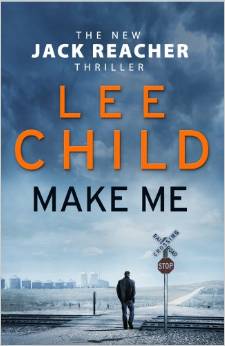
Make Me

makemeRegular readers of this blog will know that I’m a fan of Lee Child’s Jack Reacher books. They’re a comfort read. I know what I’m getting and I know I’m going to like it. I don’t expect to be surprised.

In Make Me, Reacher arrives in a small town called Mother’s Rest. He’s there on a whim, just wanting to find out why it’s called that. He finds an Michelle Chang, and ex-FBI private investigator, waiting for him. Or, at least, someone who looks like him who’s missing. Of course, there are bad things afoot and Reacher and Chang set off on an trail that leads to Chicago, LA, San Antonio and San Francisco before the final reveal. Which I did not see coming. At all. The clues are all there, but so skillfully woven in that I didn’t put it together. I loved the surprise (well, not what it was, but the fact that I was surprised) and I enjoyed this book enormously.

I also got a writing tip from it. Reacher gets a concussion in this book. It’s about time. He should get hurt a lot more than he does. Make Me is written in first person, so how do you show the effect of concussion on a character that refuses to acknowledge that he’s been hurt? Child does it through the presence of a headache but also by giving Reacher some out-of-character thoughts and feelings. It’s clear something is going on, but not clear what. Maybe Reacher is going soft in his old age and wanting to settle down. Nearer to the point where the concussion becomes unignorable, Reacher gets clumsy. Again, out-of-character. Then he faints and is taken to hospital. It’s at this point that I put together all the odd behaviours and realised what Child was doing.

Loved it. Can’t wait for the next one.


Station Eleven

stationelevenA virulent flu virus spreads like wildfire through the world. Almost everyone dies. Station Eleven by Emily St. John Mandel is the story of what happens afterwards.

Kirsten was a child when the virus struck North America, performing on stage in King Lear alongside Arthur Leander, an aging movie star. A few days later, nearly everyone is dead. The next ten years are so traumatic that Kirsten represses most of the memories. As an adult she is part of a caravan of performers, the Travelling Symphony, moving between the small settlements that remain after the collapse of civilization.

Both pre- and post-apocalyptic worlds are revealed through the stories of those whose lives intersected with Arthur’s. His first wife, Miranda, who dies in Malaysia when the virus strikes; Jeevan, a paparazzo turned paramedic who photographed Arthur; his son, Tyler, and second wife, Elizabeth; his best friend, Clark; and Kirsten, to whom he gave the comics that she carefully preserves when she’s lost everything else.

I loved this. The prose is lyrical and engaging. It’s fairly literary in style but is so well-executed that I didn’t mind. The characters are interesting and there is enough suspense in their stories to keep you turning the pages. I liked the way the stories switch between the past and the present and the connections between the characters are slowly built up. Mandel realistically presents a scenario for how the whole world might collapse in a matter of weeks if enough people die in a short space in time. It was quite chilling to think about. Definitely read this.

Shadow and Bone

shadow and boneShadow and Bone is the first in Leigh Bardugo’s Grisha trilogy. Alina Starkov is a scrawny orphan with little past and an uncertain future. As a conscript mapmaker in the First Army of Ravka she is sent across the Fold, a sea of dark magic that destroys all it covers. Her skif is attacked and, in the panic, Alina discovers she has suppressed her magickal powers. Alina is taken to the Darkling, the prince of the Grisha, and taught to use her powers.

The first half of the book is pretty slow and full of frustrating elements. I’m finding insecurity and a lack of self-belief poor obstacles for making protagonists resistant to taking on the challenges presented to them. I know it’s completely realistic and that’s how people feel, but I’m finding it boring in stories. Or maybe it’s just boring if it’s not written well. There’s some cliched mean girls bitchiness between Alina and the more privileged of the other Grisha students. The Darkling is a one hundred and twenty year old magic user and appears to be captivated by Alina. This is somewhat unbelievable, given what we know about both characters, and I was happy to discover this was misdirection.

I’ve read some reviews that suggest the Russian elements of the setting weren’t very convincing and I don’t know enough to judge myself. Alina’s immediate surroundings are well described, but the sense of the wider world was vague. I liked that Bardugo chose something different to inspire her fantasy world and nothing struck me as out of place.

The second half of the book was much better. The conflict becomes much more meaningful and the pace picks up. Alina’s understanding of the world is flipped over and she is on the run. It’s quite tense and I found myself nearly missing my stop on a couple of occasions.

It’s not the most skillfully written book but it’s not awful. It’s written in first person from Alina’s point of view but never gets right inside her head. I would rather it had been in third person. On the whole, though, I liked this. It’s a slow start but a cracking finish. I do like an exciting ending and I appreciated the twists in the middle. If you’re looking for a change of pace in your fantasy reading this could be just the thing.