Half the Sky

Sometimes there are books that really make an impression, that will stay with you for the rest of your life. Half the Sky by Nicholas D. Kristof and Sheryl Wudunn is a book like that.

It covers the experience of many women in the developing world, including sex trafficking, honour killings, lack of access to education, inadequate healthcare, maternal mortality, genital mutilation, the use of rape to control, and domestic violence. It relies on anecdote and stories to make its points, and in some places those stories are harrowing.

Nothing in this book should really come as a surprise. It’s not like these things haven’t been happening for a very long time. It is useful to be reminded once in while, but tragic that we need reminding.

There’s a lot missing from Half the Sky. There’s no real acknowledgement that these things happen in the developed world too, and the discussion of the impact of poverty is reduced to suggestions about where best to put your charity. Many of the experiences of women in this book are entrenched systemically and no amount of charity and micro-finance are going to change a global system that relies on most people being poor so that a few can be rich. And there’s very little discussion of how this inequality supports the developed world; perhaps because that might get in the way of persuading us that we can do something.

And that’s why this book is having so much impact; (not just on me, the internetz is mad for it) because it makes the reader feel like they can do something to help, something to change things. I’ve joined Kiva as a result of reading this book. I have mixed feelings about charity (it’s paternalistic, corrupt, can entrench harmful cultural attitudes) as I think it acts as a sticking plaster on wound but fails to remove the thing that cut you, but the stories in this book show how it can be positive. Change only happens in tiny steps that build up into something much bigger and this book shows what a difference the tiny steps make. What it doesn’t address is just how hard it is to build up enough tiny steps to achieve real change and that can be demoralising if you haven’t made your peace with that to start with. The thing that you do may only be a drop in the ocean, but if there were no drops there’d be no oceans.

Still, being difficult to the point of near impossibility is no reason not to do something. So, go read the book, be reminded how much there is to change and see if you’re motivated to act.
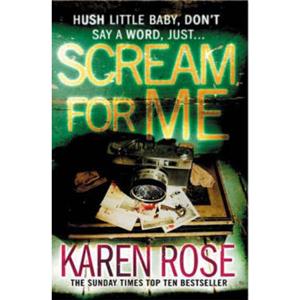
Scream for Me

I picked up Scream for Me by Karen Rose from the book drop at work. I was in the mood for something lightweight and thrilling.

Following the death of his brother, Detective Vartanian finds a collection of photographs that indicate that, when much younger, his brother participated in the gang-rape of several young women. When he goes to Dutton to investigate the murder of a woman, he realises that this death is somehow connected to those events.

Alex Fallon’s sister has gone missing and she comes to Dutton to care for her small niece and to look for her sister. The police think she’s an addict and aren’t interested in looking for her. Fallon had a twin who was murdered when they were teenagers and the MO for the current crimes is very similar. It becomes clear that the murderer is trying to reveal the rapists from Fallon and Vartanian’s childhoods, and that several important people are implicated.

This has been a strangely hard review to write. Partly because it’s a while since I read the book and it hasn’t stuck very well in my mind, and partly because I didn’t have very strong feelings about it. I enjoyed it while I was reading it, even though I thought the plot was a bit predictable. There were elements in it that should have had a high emotional impact but somehow fell flat. I guess I never believed that any of the main characters were in danger of dying. The ones that died were the minor characters that hadn’t had enough page-time to get the reader invested in them. It’s ok for a palate cleanser, but didn’t engage me enough that I’d seek out more.

A Moveable Feast and The Paris Wife

June Book Club was a double bill: A Moveable Feast by Ernest Hemingway and The Paris Wife by Paula McLain.

A Moveable Feast is a collection of vignettes recalling the years in the 1920s Hemingway spent living in Paris. Each of the people he knew there, Gertrude Stein, F. Scott Fitzgerald, Ford Maddox Ford, James Joyce, Ezra Pound and several others, has their story told. The depictions aren’t always flattering but there is a sense that all the fluff has been cut away and that Hemingway gets to the core of who people really are. While technically this is non-fiction it was written many years after the events, and knowing that Hemingway’s fiction is closely based on his life, there is the sense that story and style matter more than fact. The truth that Hemingway is in search of is a truth of the heart and mind, not the truth of reportage. The content isn’t something I’d normally enjoy; it’s a bit gossipy and has a slight feel of Heat magazine to it, but I love the writing style.

I love the deceptively simple bare bones starkness of it. I love the way every single word matters. I love the intensity and the sense of striving for emotional truth. I first read this when I was nineteen and it’s always interesting to read again the things that had a big impact when you were young, just to see whether it’s as good as you remember, or whether the greatness was fuelled by teen angst. It was better second time round. I will definitely be re-reading the rest of his work at some point soon.

The Paris Wife is the story of Hadley, Hemingway’s wife during the Paris years. Hadley is a shadowy figure in A Moveable Feast and barely gets mentioned. She isn’t even named until halfway through. It was a brave choice to write this book, given that Hemingway is one of those writers that tends to inspire irrational fandom. It starts when they meet in Chicago, tells the story of their courtship and marriage, and then the story of their time in Paris up until Hemingway falls in love with someone else and their marriage ends.

I didn’t find McLain’s portrayal of Hadley sympathetic. From the notes to the book, it seems McLain did a lot of research and tried to keep her story as factual as possible – although when I was reading the story I wasn’t convinced she’d done any research at all. For the first half of the book I was intensely annoyed; the tone was all wrong, the language was too modern and the dialogue didn’t ring true. Fortunately, it’s a very easy read so it didn’t take long to get through it. And by the halfway point I was totally engaged. The second half of the book was much better and much of what’s wrong with it would have been fixed by cutting the first 150 pages.

The Paris Wife makes an interesting counterpoint to A Moveable Feast and it’s worth reading to round out your perspective. It’s particularly illuminating about the events that became The Sun Also Rises.  Any Hemingway is worth reading.

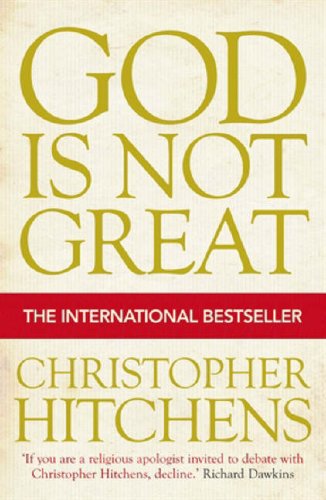
God is not Great

I don’t think I would have read God is not Great by Christopher Hitchens if it hadn’t been in the 99p kindle sale at Christmas. Maybe that was someone’s idea of irony.

The premise is that not only is there no god, or any other creative consciousness, but also that organized religion is mad, bad and dangerous to know. Using personal anecdotes, documented history and analysis of texts, Hitchens takes us through more than a dozen reasons why religion is bad for your health and probably makes you a less moral person.

I thoroughly enjoyed it, but I can’t say I had my point of view changed. I came to the book already primed to agree with Hitchens’ points. Partly because his arguments are based on a Marxist critique of religion and partly because I’ve read the Bible and came to many of the same conclusions myself. The one thing I did learn is that the Buddhists aren’t all they’re cracked up to be. Not as peaceable as you might think.

If you believe there is a God, especially one of the Abrahamic persuasion, you are unlikely to have your faith shaken. Hitchens goes in for grandstanding much more than persuasion, and I would think his tone would inspire defensiveness and rebuttal. I’m sure it would get my back up. Unfortunately, the same is true if you’re undecided. This is not a book that will commend a god-free enlightenment to you (for that, I’d recommend Towards the Light by A.C. Grayling). If you are an atheist (and I am, for all my flirting with animism/paganism), then this is a rallying cry for the cause and really good fun. Recommended or not recommended depending on your starting position.

The Quest

The Quest by Wilbur Smith is apparently the fourth book in a series (that once again I haven’t read the rest of), but I didn’t know that until I read the jacket blurb to write this post.

According to the blurb, Egypt is beset by plagues and the Pharaoh has summoned a warlock to save the country.
I didn’t get very far at all  with this. On the train I found I’d rather stare out the window than read this. I couldn’t connect at all with the characters. I think it is trying to take a mythic tone, but doesn’t quite pull it off which gives it a very insubstantial feel.
I remember reading a couple of Wilbur Smith’s novels when I was younger and quite enjoying them. This wasn’t the same at all and I’d give it a miss, unless you’re already a fan.

War and Peace

Reading War and Peace by Leo Tolstoy was my main reading goal for this year. I spend a couple of hours a day on a train and I like to use that time constructively. Some books need a bit of time and effort, and commuting makes it easy to do that. War and Peace has been pretty high on my ‘should read’ list for a long time but I’ve been put off by reports of its difficulty.

Commuting presents the best opportunity I’m going to get to tackle the hard stuff. In this case, I didn’t make it. It’s 550,000 words, which is not that daunting for fantasy readers, I think. (As an aside, wikipedia has a list of the longest novels. In Search of Lost Time, I’m coming for you).

To start with I was really enjoying it. It’s in three volumes and volume 1 is wonderful; easy to read, full of beautifully drawn characters and believable dialogue. Most of this part is set in aristocratic society in Moscow and St Petersburg and it is lovingly brought to life. Most of volume 2 was pretty good as well. The pace was good, and aside from the length, I was struggling to identify what was supposed to be so intimidating about it.

The Peace bits were better than the War bits. The parts where the action was about relationships and society were very natural and had quite a modern feel about them, in that there was little exposition and a lot of showing things on the page. The War bits were harder to read. I wondered if this was a deliberate attempt to create a feeling of discomfort in the reader or evidence of lack of familiarity with the situation. Or perhaps it’s just that a modern reader is used to more cinematic descriptions of battle. There was more exposition and less flow. I liked that Tolstoy focussed on the confusion and general wandering about of armies, rather than presenting a heroic battle.

As the book goes on there is more War and less Peace. By the time I got to volume 3 there was another problem. Tolstoy stops telling a story and starts ruminating about historical determinism, fate and the ‘great man’ theory of history. All interesting stuff, but heavy going, and all the time you want to get back to the story. I got about 85% of the way through and my reading rate had dropped to about thirty pages a day (from a high point of about 80 pages a day). I stopped to read the book for my book club and found I really didn’t want to pick War and Peace up again.

If you’ve ever wanted to read this book, I’d say give it a go. Much of it is brilliant. I never really understood what was meant when people talk about Russian fatalism, but now I do. Volumes 1 and 2 are engaging and enjoyable and it’s worth it just for that.

MicroRebellions

I have a new blogging project – MicroRebellions.

It was inspired by the confluence of two things:
1. A quote from Albert Camus “The only way to deal with an unfree world is to become so absolutely free that your very existence is an act of rebellion.” I don’t think I can immediately become absolutely free, but I can make small acts of rebellion all the time that might lead me to freedom one day.
2. The Microaggressions Project. Proof of the power of the smallest act of resistance.

Tumblr seemed the best way to collect pictures, quotes, videos and text together to inspire and record my MicroRebellions. And to let other people join in with me.

The Functions of Role-Playing Games: How Participants Create Community, Solve Problems and Explore Identity

I’m interested in identity and exploring aspects of personality and how we play parts in the various areas of our lives. All of us have different ways of being depending on the situation we find ourselves in. Who I am at work is not exactly the same as who I am with family, or with various groups of friends. For some people the differences are subtle and more about emphasising certain qualities than about being a completely different person. For others, it’s more a matter of playing a part. In my roleplaying group, I’m interested in how much the characters we create are related to who we really are. So, The Functions of Role-Playing Games: How Participants Create Community, Solve Problems and Explore Identity by Sarah Lynne Bowman really appealed to me.

The book covers the evolution and development of roleplaying, both as a leisure activity and as a training tool in military and corporate environments. It looks at the skills that can be developed and how scenarios can be used as learning tools, and refers to studies that show that learning through simulations or role-playing is more effective than book study and classroom teaching. Bowman also considers the link between play and learning in childhood and the social pressure to move on from these activities in adulthood, and what we may lose from doing so.

Bowman considers live-action roleplaying, tabletop roleplaying and computer games with roleplaying elements. She looks at the two dominant systems, Dungeons & Dragons and World of Darkness and uses personal examples to demonstrate her points. Bowman has conducted in-depth interviews with a small number of long-term roleplayers, examining their experiences and the benefits they get from roleplaying.

In the last chapter, Bowman discusses types of identity alteration as categories of character that players are likely to create. The nine types are:
The Doppelganger Self, a character very close to the player’s personality.
The Devoid Self, the player but lacking an essential quality that the player possesses in real life.
The Augmented Self, the player, but better, with some quality that the player doesn’t possess.
The Fragmented Self, a subdued aspect of the player’s personality forming the central concept of the character.
The Repressed Self, an outlet for the player’s Inner Child, a naive, innocent version of themselves.
The Idealized Self, a character with qualities the player wishes to have.
The Oppositional Self, a character completely opposite to the player’s personality.
The Experimental Self, when a player is experimenting with outlandish or bizarre concepts to see how that would work.
The Taboo Self, incorporating themes the player cannot address in real life and often directed at exploring morality.

The book as a whole was very interesting and I found it more readable than I expected to. The part I was especially drawn to was the discussion of the types at the end and the different ways in which ways of being can be explored. My observation is that some people engage with this more consciously than others and that I can see that in future I might use these ideas to explore certain themes and concepts. I would have liked more quantitative data, but I appreciate that the studies haven’t necessarily been done. I would also have liked more in-depth consideration of the nine types of character, as I found them disappointingly brief. These things aside, I really enjoyed this and would recommend it for anyone interested in psychology and identity.