The Fort

The Fort is a rare standalone novel from Bernard Cornwell.

It tells the story of an early engagement in the American War of Independence. On paper the battle should easily have been won by the Americans but it turned out to be a victory for the British.

It is very closely based on fact and Cornwell manages to bring alive the cast of characters and show how personality can make a huge difference to the outcome of a fight like this.

It’s not his best work. Of course, it’s not bad by any standard, but I’ve come to expect more from Cornwell. I think it would have benefitted from another editorial pass. There were a lot of dialogue tags which I haven’t noticed in his writing before and I feel that had it had one more rewrite these would have come out. Because of that it feels rushed.

Otherwise, this is an episode of history I knew nothing about and I enjoyed the telling of it. Cornwell is very balanced in his presentation of what happened and it is hard to pick a side. There are sympathetic characters amongst the British and the Americans. I liked it, but it’s probably one for the fans.

The God Species

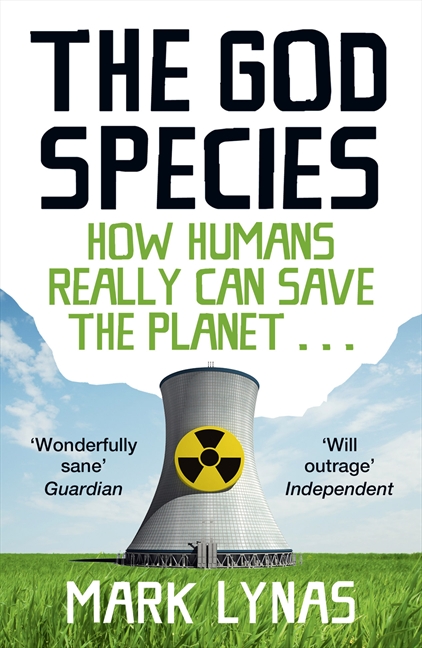
The God Species by Mark Lynam is about how humans are affecting the planetary environment and about how some of the things the environmental movement are proposing as solutions aren’t helping. Lynam explains why and suggests alternatives. Basically, technology has got us into this mess and only technology can get us out of it.
As a long time environmental activist and journalist, Lynam challenges some of the central tenets of the environmental movement. He explains the concept of planetary boundaries and shows how we can identify a point of no return for several issues including biodiversity, nitrogen, land use and ocean acidification. Given these boundaries there are some solutions that will work and some that are contributing to the problem. Lynam says that the environmental movement needs to embrace some technologies it has been vociferously against in order to achieve its goal of saving the planet.

I’m persuaded that humans are affecting the environment in ways that are damaging and that we have to do something about it. I recycle, buy organic food and try to be energy efficient. And I feel guilty that I don’t do more. But for sometime I’ve been uncomfortable with the smug, judgemental attitude that seems to go along with environmentalism, and a lot of that seems to centered around food. You’re a bad person if you don’t grow your own vegetables, eat only organic, natural food, and cook from scratch. Except that I don’t want to. It’s time-consuming and boring and I’m quite time-poor right now. Lynam argues that organic farming takes up more land and can’t support as many people. While it may be better for biodiversity than non-organic farming, Lynam argues that it is not as good for biodiversity as giving the land over to wilderness, so a better solution is genetically modified crops that need less land and more wildlife parks. I’ve never really understood why GM crops are bad, except for the practices of big agribusiness, so I like this idea. GM crops can also be developed to fix their own nitrogen and be pest resistant, meaning less use of toxic fertilisers and pesticides.

The other big issue is energy generation. Lynam argues that it is futile to take a sack-cloth and ashes approach to how we will live and says that the challenge is to find another way to meet our energy needs. The only credible answer is nuclear power supported by renewables. This is another point I’ve never understood – that nuclear is so much more scary than carbon fuels. The French have been using nuclear for ages with little apparent problem.

I enjoyed this very much. It was stimulating and caused me to change my mind about some things, and to think harder about other things. It left me feeling very positive about the future of the planet and for humanity. Defintely worth a read.

The Crisis of Global Capitalism

George Soros wrote The Crisis of Global Capitalism in 1998, in the last credit crunch. I thought it would be interesting to see if what he said was still true.

The central point of the book is that money markets aren’t based on natural laws that are always true no matter what, but are actually realities created by the beliefs held by the people participating in them. So, basically, the global financial system is a massive delusion that we all create together. I’m completely on board with that. Unfortunately, the book is written in incomprehensible gibberish. I couldn’t finish it.

The Shelters of Stone

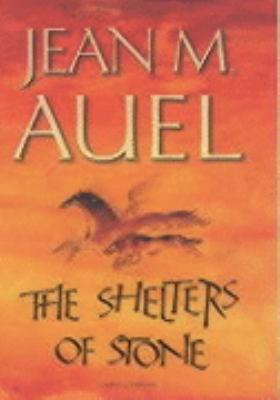
The Shelters of Stone is the fifth in the Earth’s Children series by Jean M. Auel. I read the first book, The Clan of the Cave Bear, when I was eleven and I loved it. I read it many times and it remains one of my favourite books. I’d also read the other three, with declining attachment, and the last of those hadn’t been very engaging at all.

In this instalment, Ayla comes to Jondalar’s home and learns whether she will be accepted or not.

I got about halfway through and it was a hard decision to stop reading. When I was actually reading it I found it enjoyable and it was quite an easy read. I found Ayla a little too perfect, the characters were simplistic, and the dialogue a little stilted and formal. These weren’t insurmountable issues though. This is essentially a lecture on prehistory in the form of a novel and parts of it are fascinating.

I think what really killed it for me was the lack of conflict. There’s never any real doubt that everyone will love Ayla and welcome her in, no doubt that she will teach her new family how to tame animals, no doubt that she and Jondalar will come up with lots of new inventions. But given the choice of spending an hour on the train reading this or doing something else I found I was quite keen to do anything else.

The Way We Live Now

Free kindle books! Yay. There are books now out of copyright that are available free for the kindle and I have availed myself of a few. One of them is The Way We Live Now by Anthony Trollope which I wanted to read as it was mentioned in an article on The Business Case for Reading Novels.

Mr Melmotte arrives in London amidst rumours of vast wealth, shady deals and a lack of breeding. It is set in London in 1870 and there are several lordlets in search of an heiress. Melmotte’s wealth is reckoned to be so great it overrides any considerations that he might be a commoner.

One of the lordlets is Felix Carbury whose mother has decided that she will make a living (she has to because her son gambles away her money) writing books. She surmises that it is more important to persuade influential critics to say her books are good than it is to actually write good books. Felix’s sister, Hetta, has an offer of marriage from her cousin, Roger Carbury, who is a model of virtue. But she is in love with Paul Montague, a hapless young man who is manipulated into investing his entire wealth in a transamerican railway and finds it hard to disentangle himself from a previous engagement.

Melmotte is brought in on the railway scam and the share price rises. Melmotte’s wealth is reckoned to be incalculable and his ego is flattered to the point that he is persuaded to stand for parliament. Then everything starts to unravel.

This was originally published as a serial and occasionally there is a bit of recapping. Obviously this is a very old book so there’s not much to say about style – it is of its time. However, I found it highly readable and was completely absorbed. None of the characters really come out well and yet it is hard to say who is really bad.

It was funny in places and is very relevant to the current economic climate. I was a little disppointed by the ending and would have preferred a less fairytale resolution, but that’s a minor point. Overall it was an excellent read and I recommend it.

Writing is a funny thing

I had a bit of break at Christmas and I took the opportunity to think about how the elements of my life fit together and where I’m spending my time. I decided I was going to work out how to reduce the amount of time I spend commuting and that I would put writing on the back burner while I sorted that out.

Ever since then I’ve been writing loads. Opportunities to reduce my commute are few and far between so that hasn’t been taking up as much time as I thought. My novel is very much on the shelf, but I have a collection of short stories underway. I’m writing fiction based on my roleplaying games and am chronicling our current campaign at the London Storytelling Carrion Crown Campaign blog.

I haven’t written this much in ages and I think it’s because I’m supposed to be doing other things.

What I think I do

I love a meme. Have I mentioned that?

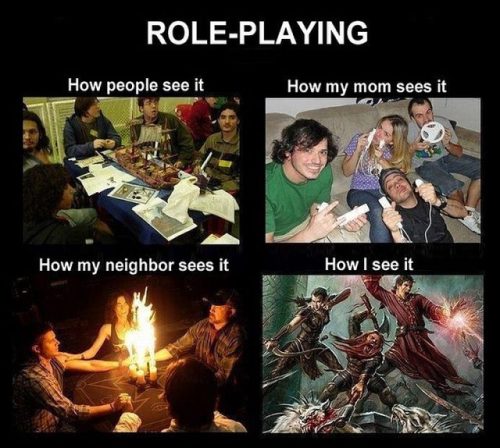
The latest meme I have particularly liked is the ‘What I think I do’ poster. Here are two that apply to me. And yes, this is what I think I do.

These were sent to me so I can’t link to the originator. I would give credit if I could. 
This entry was posted on February 20, 2012, in Fun. 1 Comment

The Particular Sadness of Lemon Cake

The first thing to say about The Particular Sadness of Lemon Cake by Aimee Bender is that it has a great title. It’s evocative and intriguing, the rhythm is good and is the sort of title that makes me wish I had a talent for titling things.

At the age of nine Rose discovers she can taste emotions in the food she eats. If it is manufactured food she can tell all the layers that contributed to creating it. If it is homemade she can taste how the person who made it was feeling. She finds that people around her feel things that they don’t display on the surface and she struggles to work out a way to manage it.

Rose’s brother Joseph is quiet and reclusive. As he reaches his late teens he starts to disappear in mysterious ways. Their mother is frantic and their father is distant. Eventually Joseph disappears and doesn’t come back. Rose feels she can’t move out now, but gradually she finds a way to use her gift and have a life of her own.

It’s an easy read but the title really is the best thing about it. The powers that Rose and her brother have are not explained until the end when their father reveals that his father had a similar power. I found this element of the book unsatisfying. I could have accepted any number of causes had an effort been made to provide one.

The description of the emotions in the food could have been richer and more detailed. I thought that they were flat and I found them disappointing. What I did like was the concept; it’s an interesting idea. The execution didn’t do it justice and didn’t live up to the title.

I wasn’t keen on the writing style, even acknowledging that anything read after Babel Tower would suffer by comparison, and I found it difficult to engage with the characters. It was not so bad that I couldn’t finish it but I would certainly avoid anything else by this author.

Babel Tower

One of my top ten books is Possession by A. S. Byatt and so it stands to reason that I would like other books by the same author. I read Angels and Insects and wasn’t blown away. I bought Babel Tower and it has sat on my bookshelf for ten years. Part of the reason I haven’t read it is that it is a hardback and is 615 pages. The other part is that I was worried I wouldn’t like it. Oh, how wrong I was.

On the surface it is the story of Frederica Potter, a woman who was a Cambridge graduate in the early 1960s, then her sister died and while she was grieving she married an inappropriate man. At the start of Babel Tower Frederica has a two year old and is realising that she made a mistake in her marriage. When she runs into an old friend it accelerates this realisation. The cracks in her marriage widen and her husband becomes extremely jealous and violent. After he hits her with an axe, she leaves and begins a life in London.

There Frederica renews old friendships and makes new ones, including one with the author of a book which is tried under the Obscenity Act. At the same time, Frederica starts divorce proceedings. What the book is really about is the terrible position and treatment of women in the 1960s and it is very feminist. It is also about the nature of art and about obscenity, morality and freedom of expression.

The quality of the writing is astonishing. It was so rich and complex without ever becoming florid. I wish I could write like this. On every page I was in awe. It is the third in a series of four and, of course, I haven’t read any of the others but it easily stands on its own. Byatt is a literary writer who is gripping, tense and utterly absorbing. This was amazing and I could barely put it down. You should definitely read it.