Archives

100 Books in 2011 Review: Size 14 is not Fat Either

Size 14 is not Fat Either is the second Heather Wells mystery by Meg Cabot. Heather is an ex-popstar trying to start a new life working at a college in exchange for free tuition. Students keep dying, the police are useless, Heather stumbles around investigating but not and inadvertently getting into danger. Of course, she has the obligatory complicated private life – a popstar ex-boyfriend whose private detective brother is her landlord and a student with a crush. And her Dad turns up to live with her after spending 20 years in jail.

The size 14 (18UK) is a reference to the fact that Heather is a little overweight. I found it quite difficult to work out whether this was size positive or not. It starts with Heather getting some off-hand negative comments from a barista she fancies which sparks some self-hating inner monologue. Overall, Heather is a competent woman struggling to adapt to a radically new life against the pressure of friends and family. She has come from an incredibly image conscious industry and one could argue that her self-talk could be a lot worse.

Writing-wise, it’s good. It’s not stand-out spectacular, but it’s good. Dialogue is effective and Cabot creates rounded, well-drawn characters. Even the bit-part characters get a bit of personality. The plot works out in a convincing satisfying way, although the motives of the killers seem somewhat light for the gruesome murder committed. However, this is chick-lit and it’s supposed to be an easy read. Cabot has a light, assured touch suitable for the genre. If you’re looking for something fun and relaxing, you could do worse.

100 Books in 2011 Review: The Taking

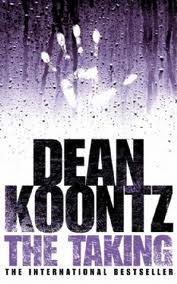
Dean Koontz is one of those popular writers who are considered to be technically very good and a few years ago I read Intensity. The concept of the book was that the writing should be intense to reflect the story and it really worked. Intensity was amazing. So I was looking forward to reading The Taking. I thought it would be a well written, fast paced thriller.

Sometimes I can be very wrong about things.

The Taking is the story of a woman who wakes up to a weird fog and rain. She discovers that the whole world is affected and as the television broadcasts stutter out, she and her husband leave their mountain home to go in search of other humanity. They decide that their job is to gather up the parentless children. People have different reactions to the eerie weather and the things that start to appear in it. It seems that the earth is being terraformed by aliens but all is not what it appears.

The concept that the earth is being terraformed by aliens is a really interesting one. Terraforming is usually thought about in terms of making another planet suitable for human life and I liked the idea of flipping that about. How would that feel? What would we do about it?

Unfortunately, that’s not really what The Taking about. And I will reveal the twist because, believe me, it is not worth reading this book to find it out. The Taking is a second cleansing of an immoral humanity by the Abrahamic God; a second flood. It reverses Arthur C. Clarke’s law that any sufficiently advanced technology is indistinguishable from magic to say that technologically advanced, faithless people will interpret world-shattering supernatural events as the technology of a much more advanced species. This is a story about God saving the good and destroying the bad and I find that so much less interesting.

So, I didn’t like the story, but what about the execution of it? I felt it was poor. And certainly not up to the standard I remember Intensity was. It’s mainly telling. We are told what Molly, the protagonist and POV character, is feeling. We are given her backstory in small but awkward lumps. The interaction between her and the other characters is described and rarely shown. There was very little dialogue and I think that is really the vehicle that authors use to turn telling into showing. I found the book to be silent. No one was talking in my head. I thought that would be amazing in a film where the use of silence has a disturbing, creepy effect but it wasn’t coming across on the page.

The supporting cast of characters were flimsy and even Molly didn’t have much personality. The interactions between them are sparse and devoid of connection. The description was ok. In fact, I did keep thinking this would really work as a film, but as a book it lacked depth. And dialogue. Which is not how I remember Intensity.

So, in all, I will probably read more Dean Koontz as so far he has been 50% amazing and 50% awful, so I need to read at least one more to tip the balance. If you are going to try Koontz, don’t pick this book.

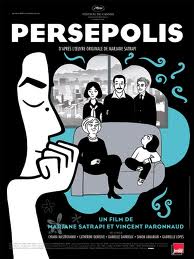
100 Books in 2011 Review: Persepolis

I’ve decided graphic novels count towards the 100 books challenge, which is good, because this gave me a chance to catch up a bit this week. Still behind target though; last week was week 13 and I should have read 26 books by the end of it. I’ve only read 22. At some point, I’m going to have to read some really short books. Maybe some more graphic novels.

The March book for my work book club was Persepolis by Marjane Satrapi. Having seen the film (and enjoyed it), I was looking forward to this.

It is the memoir of an Iranian woman, dealing with her childhood in Iran around the time of the revolution i.e. the late seventies and the eighties. She is the child of Marxists intellectuals and the great-granddaughter of the last Emperor. The book shows how her life was affected by the increasing restrictions on freedom of speech and movement. For a few months she lives in Austria, which provides different challenges.

It’s marvellous. It is so moving, both sad and funny. Satrapi reveals the things that had the greatest impact and is brutally honest with herself and her actions. Sometimes she leaves the emotion quite raw and at other times she gently pokes fun at herself. Given that there are so few words, she uses them to great effect.

This was lovely. And educational. So far this year book club has been swinging from one extreme to another – from amazing to turgid and back to amazing again this month. Persepolis is highly recommended.

100 Books in 2011 Review: Reaper’s Gale

I’m now behind target with my 100 books challenge and this is the reason why. Reaper’s Gale by Steven Erikson is book 7 in the Malazan Book of the Fallen and it’s a massive 900 pages. Not only is it long, it’s dense. There’s a lot going on and it took me two weeks to read it.

The story, at a fairly simplified level, is the fall of the Letherii Empire. There are a lot of storylines that weave together to create the story including characters in the Letherii army and secret police, characters amongst the Tiste Edur who have recently conquered Letherii, characters among the invading Malazan army and a handful of gods and their offspring.

There are a lot of characters in this book. On the one hand this is good. I like big, sprawling fantasy with a good selection of points of view. Some characters are really interesting and others less so. I did think that there were too many point of view characters and that there was enough time to really get to know the ones I liked best. Which is saying something in a 900 page book. Maybe it’s because this is book 7 and I haven’t read books 1 to 6. This is what happens when you join book clubs to get a million books for no money and then forget to tell them you don’t want the editor’s choice. You end up with loads of books from the middle of a series and never get around to reading the first ones.

One point I did take away from this book is that when you have several point of view characters it is not always necessary to show every step they take on the journey. Showing key scenes builds up the story without any waste. However, I do think you need a large cast to do this.

The writing is amazing. It is all show. There’s very little exposition and loads of dialogue. Reading this really brought home how dialogue can move a story forward, And that’s not all the dialogue does in this story; it does characterization, theme and exposition. It never feels stilted or forced. The description of the various worlds is beautifully done and doesn’t interfere with the action and dialogue. Instead it supports it.

I really enjoyed this, even though I wasn’t entirely sure what was going on – that would be the six books I haven’t read yet. I liked it enough to want to read the rest of the series and then this one again.

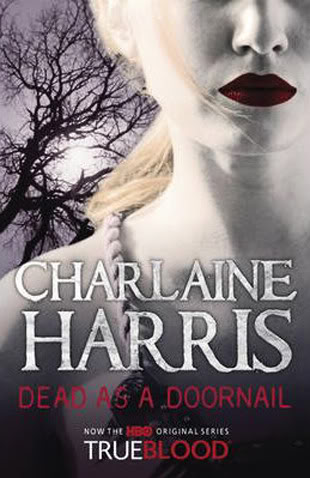
100 Books in 2011 review: Dead as a Doornail

Dead as a Doornail is the fifth in Charlaine Harris’s Sookie Stackhouse series. In honour of the fact that there’s a review for each one on this blog I’ve created a new category just for these. (Having just done that, it appears I missed one. There’s no review for Dead to the World, which I’m sure I read, but I don’t keep books so can’t go back to it. Annoying.)

Anyway, moving on. When I started reading the Sookie Stackhouse series it was because I was really enjoying True Blood and I was curious to see how the TV series would be different to the book. With season 2, True Blood diverged quite a bit so it was not really possible to compare it with Living Dead in Dallas. There is one point that is still worth picking up.

That point is about character. Almost all of the supporting characters have greater depth in True Blood. I said that I thought this was a combination of first person POV in the books and the greater space for character development in the TV series. By book five, I’m beginning to wonder if that’s really what’s going on. The characters that have been in the books from the beginning are still quite thin, with the exception of Eric who is more real. It was notable in this book that the characters that are here for just this story are a name, a brief physical description and a tic or two. While the writing is noticeably more competent than it was in the first book, characterisation isn’t much better. Having read lots of first person POV books in the last couple of years (and having been paying attention to the writing) I don’t think that this POV necessarily leads to poor characterisation. Some writers manage to do it well.

What really rankled was the poverty of female characters. There was a lot about Sookie that made her a great female character to start with and I felt that some of this is becoming lost. Tara is Sookie’s best friend but she has barely any impact on the story. In this novel, it felt like she was only there as a plot device. The best friend relationship is never established except for Sookie telling us this. The two of them don’t seem to spend time together and Tara is not who Sookie goes to for emotional support. She is certainly not the intriguing, complex character that she is in True Blood. The same is true for Arlene. In Dead as a Doornail, Sookie is surrounded by various supernatural men who are desperate to get with her. They are literally lining up. Which basically makes this a book about a hot chick who has all the dudes after her and no meaningful relationships with anyone. Disappointing. And much less feminist than it was because it reduces Sookie to an object to be possessed.

Sookie’s feminist credentials also slip in terms of the plot of Dead as a Doornail. In Dead until Dark, Sookie investigates, takes action, and eventually saves herself and I loved that. In Dead as a Doornail, stuff is done to Sookie, she’s manipulated into participating into things, and other people save her. The plot is that someone is shooting shifters and her brother is implicated. Or at least, it says he is on the back of the book but I didn’t feel that came across particularly well. In fact, the culprit is a minor character who appears to have the red shirt role. At the end, I felt a bit cheated by the resolution of the plot.

In spite of these major problems, I did still enjoy Dead as a Doornail. It’s an easy read and not very long. It’s fun and undemanding.

100 Books in 2011 review: Aces High

Aces High is the second in a shared world series edited by George R. R. Martin. It’s alternate history sci-fi which takes the 1950s as its jumping off point and postulates that a virus outbreak creates mutated humans. Some get superpowe

rs and others get physical and mental disfigurements. The first book deals with people coping with becoming either an ace (superpowers, normal looking) or a joker (physical and mental disfigurements).

In the second book, set in the 80s, both aces and jokers are fighting alien invasion. It’s a series of short stories, written by a number of leading sci-fi writers, that builds up a story arc over the whole book.

I’m not really into superhero stuff but I quite like these. The writing is variable in style (not in quality) but all the stories blend well together. It has a kind of noir-ish feel, is a little bit pulpy and comicky, and is perhaps a little dated. But overall, it’s fun, lightweight, easy reading.

100 Books in 2011 review: The Heroes

This one is hot off the press! For me at least. Every so often a book comes out that I’m so excited about I buy it in hardback as soon as it’s published. I’m a fan of Joe Abercrombie’s work and his latest book, The Heroes, came out at the end of January. I bought it and read it immediately.

The Heroes follows three characters during a three day battle at a henge called the Heroes. Bremer dan Gorst is on the side of the Union, has lost everything and is trying to redeem himself through the only thing that ever gave him any sense of self-worth – fighting. Curnden Craw has been a warrior all his life and now he’s tired and struggling to work out what the right thing to do it. Prince Calder is a dispossessed prince trying to figure out how to make himself King of the North without doing any actual fighting himself.

This is a book about heroism in all its glory and stupidity. It’s also about the horrible reality that is lost in the glare of heroism but without which it wouldn’t be possible. Abercrombie pretty much does everything well but his stand-out skill is characterisation. His main characters are not always very likeable; what they are is identifiable. He reveals their inner conflicts, fears, self-delusion and insecurities in a way that opens them up to us as real people. We may not like them but we understand them. I particularly enjoyed the layering of Bremer dan Gorst’s crippling loneliness throughout his POV chapters.

I like the way the story uses several POVs. As well as the three main characters there are three minor characters who have story arcs through the book and a handful of others who get the odd occasion to talk. There is one chapter, called Casualties, where each scene is from the point of view of an individual who gets killed in one of the engagements. A character has a scene, is killed, and then the POV switches to the head of the character who killed them. And is in turned killed and the POV passes to the next killer. This lasts for six characters and the last is one of the main characters. I honestly didn’t know whether he would be last, or whether he would die. Abercrombie doesn’t necessarily keep his characters alive to the end of the book. He’s prepared to do what the story requires and my heart was in my mouth for the whole of that scene. Genius.

Abercrombie is a visual writer who creates scenes quite filmicly, probably as a result of his previous life as a film editor. His action scenes are full of detail, movement, and sensory information. The worldbuilding is good, but lighthanded, at least for me. I’ve read all of Abercrombie’s books and the world is familiar to me. My only criticism would be the lack of female characters. Abercrombie writes women well – meaning that he writes them as people who happen to be female – and has created some really memorable female characters. There were only two (aside from background characters) in The Heroes, who were great, but had small roles and I would have liked more balance.

The ending was really a mix of endings. Each of the six main and minor characters come to a turning point in their lives. Most get what they wanted but find that it’s not quite what they thought it would be. Two thought they wanted a life that was different from what they had, but when they get it, find that what they had was better. One finds that getting what she wants comes with a very high price. Another finds that getting what he wants doesn’t solve his problems or make his life any better. One gets what he thought he wanted but gives it up when he sees that what he wants really comes in a different package. And Sargeant Tunny finds himself right back where he started. I find it insightful and realistic. It’s satisfying because it speaks to emotional and psychological truth.

I loved it. This is modern fantasy at its finest. And I can’t wait for the next one. Highly recommended.

100 Books in 2011 review: Stet

I’m sticking to my policy of not reviewing non-fiction even though many of the 100 books I’ll read this year will be non-fiction. I’m making an exception for Stet by Diana Athill because it was the February choice for my book club.

It is a memoir by someone who worked as an editor all her life. The book is in two halves. The first is a potted history of the author and the second is a series of vignettes about some of the authors with whom she worked. Those authors are Mordecai Richler, Brian Moore, Jean Rhys, Alfred Chester, V. S. Naipaul and Molly Keane.

I was quite excited about reading this. I’m not really interested in memoirs and biographies, but I thought that reading about someone who worked with words would be different. I was looking forward to an exploration of the art of editing.

That’s not what this book is about. Part one is a charmingly written precis of Athill’s life. It’s a long life and there is only a hundred and twenty eight pages to cover it. Which means that there is not much depth. Athill talks about how she became an editor, her relationships with her colleagues, the development of the publishing company she worked with and its eventual decline. She doesn’t really talk about editing except to say that some writers need more work than others. At only one point is there a sense that she helped to create a book and that was a book about Myra Hindley that the author found psychologically difficult. It was disappointing for me that Athill didn’t spend more time talking about the art of editing.

The authors in the second half of the book are mostly unknown to me. I read Wide Sargasso Sea by Jean Rhys and loved it, but I’ve read nothing else of hers. I read A House for Mr Biswas by V. S. Naipaul and hated it, but again, I’ve not read anything else. The others I know nothing of. I find that I don’t really want to know too much about artists, whether they are writers, actors, musicians or any other kind. If you enjoy someone’s work, you kind of have a fantasy about who they are. I tend to imagine that the authors I like are terribly clever, erudite, cultured and suave, with liberal, progressive politics. And of course, they’re not always like that. Surprisingly, they’re human and ordinary. Being a fantasist, I find that reality doesn’t live up to what I can imagine – perhaps that’s why I love speculative fiction!

So, I slogged through the vignettes. Like the first part of the book, they were charmingly written and lacking depth. I found the whole thing just dull. In fact I was so bored I skipped the book club meeting because I couldn’t face talking about this book for an hour.

100 Books in 2011 review: Free Fall

I bought Free Fall by Robert Crais in a book buying addiction frenzy in Asda. They were selling a ton of books for a pound each. How am I supposed to not buy books if they do that??

Anyway, I was in the mood for easy-going fluff, and I have a book target to meet, so this seemed like a quick win.

This is an Elvis Cole and Joe Pike novel. A young woman thinks her policeman fiance is in trouble. It turns out to be much more trouble than anyone bargained for involving blackmail and murder.

It’s fun, easy reading. Cole and Pike are more likeable than some of their ilk (yeah, Jack Reacher, I mean you). They are not complex characters but neither are they flat and stereotypical. Some of the supporting characters get well fleshed out as well. Others don’t, notably the villains. The plot cracks along at a good pace and there are one or two nice thoughtful moments. It’s entertaining and if you’re looking for a light read, you could do worse than this.

100 Books in 2011 review: The Number of the Beast

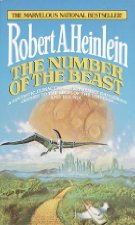
The Number of the Beast by Robert A. Heinlein is one of his later novels (published in 1980) and is not just a story.

The basic plotline is two couples in a time machine travelling through a series of universes, more or less similar to our own, alternately running from and chasing the villains that tried to kill them at the start of the story.

But what it really is, is a homage to 1930s pulp science fiction. The style is dated and the characters are Heinlein usual combination of intellectual brilliance, excessive heteronormative sexuality and stereotypical gender norms. Interestingly, Heinlein spends some time exploring the unconscious ways in which men undermine women’s assertion of equal rights and self-determination while believing that they are being supportive. It is surprisingly insightful, given Heinlein’s justified reputation for reactionary thinking.

The book is full of in-jokes, most of which I didn’t get, not being steeped in the fiction which the book is paying homage to. I liked the concept of fictons – that somewhere in the multiverse any fictional world thought of pops into existence. That would be cool. Of course, Lilliput, Barsoom, Oz and Wonderland wouldn’t be the worlds I’d choose to visit but there you go.

I hated the ending where Heinlein brings all his characters together for a big, self-congratulatory conference. This is strictly one for the fans.

So, if you could visit any fictional world/universe where would you choose to go? I’d go to Sunnydale, Westeros and the Culture.